
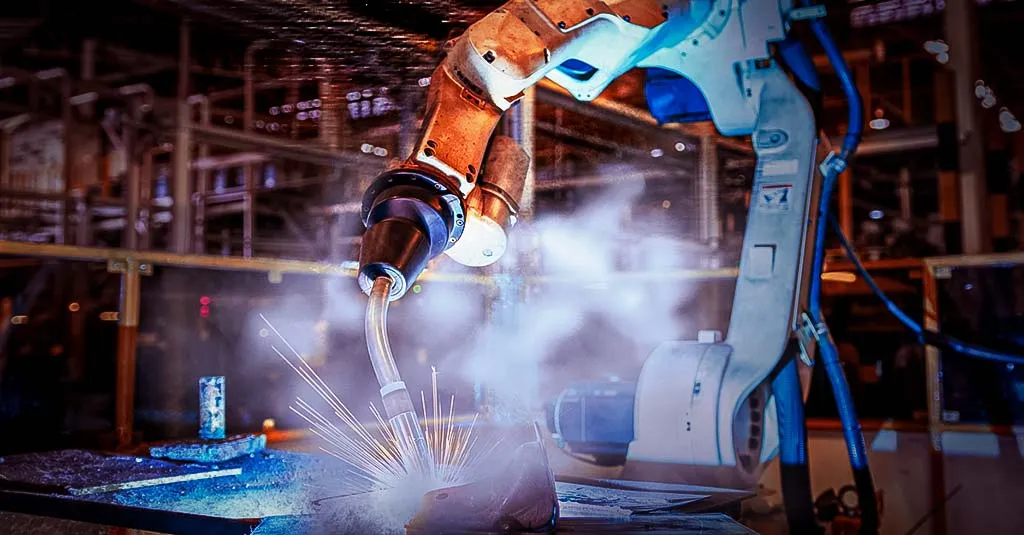
Robotic welding solutions have become almost ubiquitous in modern production facilities. With the evolution of technology, robots are now used across numerous industries — and even in our homes — becoming more widespread every day.
With the Industry 4.0 Revolution, robotic systems have become essential in nearly every area of manufacturing.
Among all applications, the most common use of robotics is undoubtedly in robotic welding operations.
But here’s a question — while investing in robotic welding to improve your production efficiency and reduce human error,
have you ever considered the damage caused by welding fumes?
When we ask this question, the three most common responses we hear are:
 There’s no operator at the robot — we don’t need a fume extraction system!
 The doors and windows are open — ventilation is enough!
 We have a powerful fan on the factory roof — that should do it!
In reality, many assume that because the robot is mechanical, it cannot be affected by welding fumes.
But what happens when those fumes spread throughout the workspace?
Have you considered what might occur if the fume particles adhere to the robot’s surfaces and components?
If the welded materials are even slightly oily, the robot’s consumable parts will need frequent replacement, and the lifespan of robotic components will inevitably decrease due to fume exposure.
Without proper fume extraction, the welding fumes released into the air can threaten the health of your other employees in nearby departments.
Your multi-million-dollar robotic investment could result in costly maintenance expenses caused by uncontrolled fume contamination.
The second major risk: improper fume extraction systems.
Many companies try to solve the fume problem economically by surrounding their welding robots with kitchen-style exhaust hoods, galvanized ducts, and small fans — assuming it’s a sufficient solution.
However, these setups not only look unprofessional but also take up unnecessary space and operate with very low efficiency.
One of the most common design mistakes in robotic welding fume extraction is enclosing the entire robot (except for self-contained cabin systems).
So how can we protect robotic welding systems effectively?
In robotic welding, the process doesn’t occur directly on the robot but on sliders, positioners, or a fixed workstation. Therefore, capturing fumes only at the welding point is sufficient.
This design improves system efficiency, prevents the need for oversized fans, and reduces energy consumption by using smaller extraction motors.
In robotic welding setups where cranes operate, fixed hoods are impractical.
In such cases, instead of large hoods, high-vacuum FRESHWELD TORFIL systems — which integrate directly into the robot torch — can be applied for targeted fume extraction.
Finally, it’s worth repeating: extracting fumes from your facility only to discharge them unfiltered into the atmosphere is both ethically and legally unacceptable.
FRESHWELD provides advanced Robotic Welding Fume Extraction Solutions in collaboration with INTECRO Robotics.
For tailored solutions and expert recommendations for your specific application, please contact our sales representatives.