
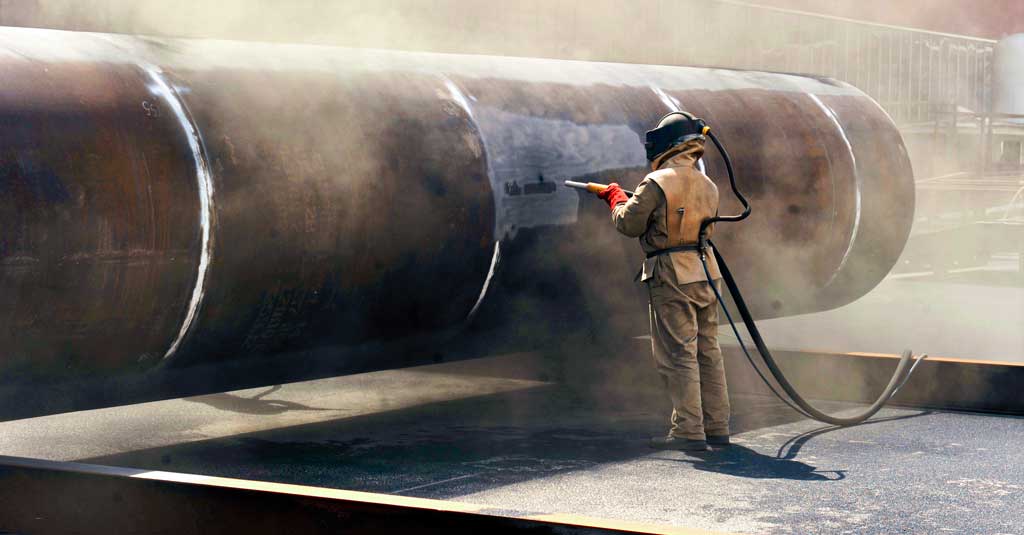
WHAT IS SANDBLASTING? HOW IS IT DONE?
Sandblasting is an application used to extend the service life of metal by removing dirt, rust, and oil from its surface caused by corrosion over time.
Sandblasting is the process of propelling abrasive media at high pressure against a metal surface. This treatment prepares the surface smoothly for paint application.
Open-area sandblasting requires sandblasting pots. Such open systems are used in shipyards or for blasting large structures.
For medium-sized parts, smaller sandblasting cabinets are used.Surface cleaning of the parts is carried out inside these cabinets. Compact and enclosed sandblasting cabinets are ideal for companies with limited space.
Which Sandblasting Method? Automatic Sandblasting or Manual Sandblasting
For profiles, sheet materials, or pre-welded steel components, turbine-powered automatic sandblasting machines and sandblasting cabinets are typically used.
The main advantage of a fully automatic system is the ability to blast suitable-sized materials quickly and cost-effectively. The drawback is that large parts cannot fit into automatic machines.
For example, ships in shipyards or heavy machinery cannot be placed inside automatic sandblasting machines. In such cases, manual sandblasting is applied.
BEWARE OF EXTRACTION SYSTEMS WITH HIGH AIRFLOW BUT LOW FILTRATION AREA!
In sandblasting applications, you must pay attention to filtration velocity to avoid frequent maintenance intervals and short filter lifespan in your sandblasting dust collector. Choosing filters with a low filtration area may reduce initial investment, but high filtration velocity will cause filters to clog quickly. This not only increases maintenance costs but also poses a potential fire hazard.
DUST AND FUME HAZARDS IN SANDBLASTING APPLICATIONS
Sandblasting requires special abrasive materials called grit.
While it removes visible and micron-sized rust and corrosion from the surface, it also reveals the raw metal underneath. During sandblasting, dust becomes heavily airborne inside the sandblasting cabinet.
Capturing this dust is essential to improve blasting quality.
At the same time, operators working with sandblasting machines are inevitably exposed to dust. Before manufacturing quality, human health must come first. Therefore, dust must be minimized and filtered in compliance with Occupational Safety and environmental standards.

DUST GENERATED DURING SANDBLASTING AND ITS COLLECTION

The dust generated during sandblasting poses serious risks to both human health and environmental safety, potentially leading to fatal consequences.
Although some dust may seem harmless, prolonged exposure can create multiple hazards.
The risk of fire and explosion must always be considered, and preventive measures must be implemented. The fact that no accidents have occurred in the past does not guarantee safety in the future.
Dust generated during sandblasting can ignite or explode due to sparks during operation or unexpected static discharge. Therefore, fire and explosion risks must be addressed separately with appropriate safety measures.
 Explosion Risk
Explosion risks can be anticipated depending on the material being blasted and can be prevented with solutions compliant with ATEX directives .
.
This ensures that in case of an explosion, the blast is safely directed, minimizing damage to the environment.
 Fire Risk
Properly designed and well-equipped sandblasting dust extractors minimize or even eliminate fire risks. Fires in dust collection systems often occur due to excessive dust accumulation. To prevent buildup, extraction hoods must be designed correctly and positioned for optimal performance.