
Before diving into our article on plasma cutting and industrial filtration, it is useful to recall the four basic states of matter:
- Solid
- Liquid
- Gas
- Plasma
WHAT IS CNC PLASMA CUTTING?
Plasma is known as the fourth state of matter.
The factors that make plasma one of today’s most widely used cutting technologies are its high cut quality, high efficiency, and versatility.
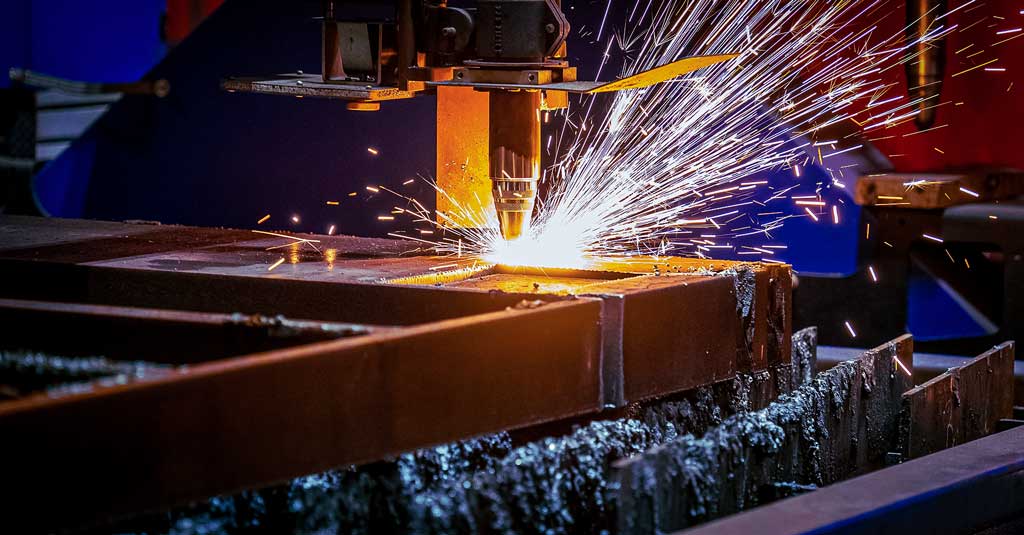
CNC plasma cutting is the process of cutting conductive materials by ionizing compressed air into plasma using a direct current power source.
The major advantage of plasma cutting is that it can be applied to all conductive metals, including:
- Mild Steel
- Carbon Steel
- Stainless Steel
- Aluminum, Copper
- Brass and other metals
PLASMA CUTTING CAN BE MANUAL OR MECHANIZED
In mechanized cutting applications, plasma cutting software is used to program the cutting machine.
In some cases, CNC software may be sufficient for programming independent parts or low-volume work. However, most manufacturers and fabricators prefer CAD/CAM nesting software, which offers advanced features and capabilities.
Plasma cutting is also used for gouging applications thanks to its technology. Common plasma cutting applications include:
- Straight cutting
- Bevel cutting
- Gouging
- Hole cutting
- Remote cutting and gouging
- Fine feature cutting
- Marking
To perform the cutting process, you need a power source, constant compressed air supply, and the appropriate torch.
Power Source
This is a constant current DC power supply. The open-circuit voltage usually ranges between 240 and 400 VDC. The output current (amperage) defines the system’s cutting speed and thickness capacity.
Its main function is to provide the correct energy to maintain the plasma arc after ionization.
Arc Starting Circuit
For liquid-cooled torches rated at 130 amps and above, this is typically a high-frequency generator producing AC voltage in the range of 5,000–10,000 volts at about 2 MHz. This voltage ionizes the gas inside the torch to generate a dense arc for plasma production.
Air plasma torches, unlike high-frequency starting circuits, often use a moving electrode or so-called “blowback start” technology to ionize the gas.
Torch
The torch holds the consumable nozzle and electrode, ensuring their cooling (via gas or water). The nozzle and electrode constrict and sustain the plasma jet.
FUME AND PARTICULATE EMISSIONS DURING PLASMA CUTTING
It has been scientifically proven that the particles generated during plasma cutting are carcinogenic.
Workshops and facilities using plasma cutting must implement an effective fume and dust filtration system.
OSHA (Occupational Safety and Health Administration, USA) has established permissible exposure limits for particles released during plasma cutting after years of research.
| PARTICLE TYPE | MAXIMUM PERMISSIBLE EXPOSURE LIMIT |
|---|---|
| CHROMIUM | 0.1 mg/Nm³ |
| COPPER | 0.2 mg/Nm³ |
| MANGANESE | 0.2 mg/Nm³ |
| NICKEL | 1.5 mg/Nm³ |
| SILICA | 2.0 mg/Nm³ |
| IRON OXIDE | 5.0 mg/Nm³ |
| ALUMINUM OXIDE | 10 mg/Nm³ |
| MAGNESIUM OXIDE | 10 mg/Nm³ |
WHAT TO CONSIDER WHEN CHOOSING A FILTER UNIT FOR PLASMA CUTTING SYSTEMS?
To properly integrate a filter unit into plasma cutting technology, it is necessary to know the material type and thickness, the capacity of the power source, and the cutting speed, and design accordingly.
Once the required airflow and fan resistance are calculated, the final step is selecting the right filters for the system.
Many plasma cutting machine manufacturers offer low-cost, unprojected filter systems just as an option to differentiate themselves from competitors.
Unfortunately, most customers end up replacing these filtration systems later, resulting in wasted investment.
Using an improper filtration unit in plasma cutting can lead to very serious hazards.
The main reason is the intense sparks generated during plasma cutting:
- Sparks can quickly reach dust accumulation areas or filters, causing large and difficult-to-extinguish fires.
- During Plasma, Laser, and Oxy-fuel cutting, a minimum of MERV 15 filters must be used for effective dust and fume filtration.
- Filters must be flame-retardant and self-extinguishing.
- Since the particles generated are extremely fine, filter media must be coated to capture micron-sized particulates effectively.
This way, in case of a fire, the filters self-extinguish, creating a safe environment, while the coating technology ensures long service life and high fine dust capture efficiency.
FRESHWELD recommends filters engineered with Donaldson Ultra-Web® filter media, which are self-extinguishing and specifically designed for Plasma Cutting Dust and Fume Filtration.
Filters manufactured from an 80/20 blend—80% cellulose and 20% polyester—and coated with Ultra-Web Nanofiber technology provide long filter life, self-extinguishing capability, and superior fine dust capture—all in a single filter.
WHAT IS ULTRA-WEB® FILTER TECHNOLOGY?
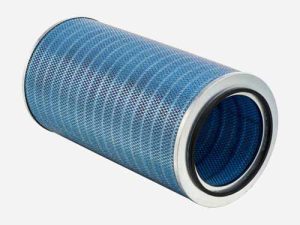
The proven and patented Ultra-Web® technology delivers longer filter life, cleaner air, and significant cost savings compared to other cartridge filter media.
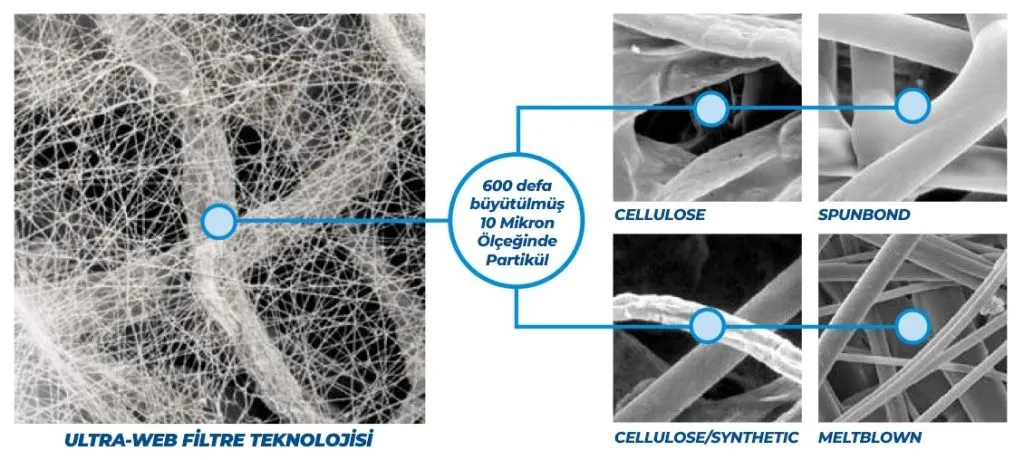
Manufactured using an electro-spinning process that produces extremely fine, continuous, flexible fibers with diameters of 0.2–0.3 microns, Ultra-Web creates a permanent fine-fiber web with microscopic pores that trap dust particles on the surface.
- More efficient at capturing submicron dust particles
- Provides longer filter life and better cleaning efficiency thanks to surface-loading technology
- Lower operating pressure drop results in reduced energy and compressed air consumption
- Delivers MERV 14 and MERV 15 filtration efficiency for specialized industrial filtration needs
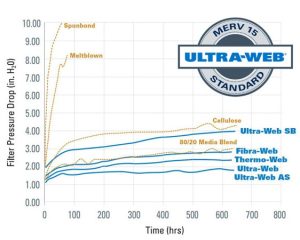 Ultra-Web Filters are independently tested and certified to MERV 14 and 15 efficiencies, according to ASHRAE Standard 52.2-2007, the industry benchmark for filter performance evaluation.
During ASHRAE 52.2 testing, filters must achieve at least a MERV 13 rating on the ASHRAE 20-point scale to effectively capture submicron dust particles.
Contact Our Technical Team and Let's Choose the Right Product TogetherAchieve Significant Savings
Experienced engineers recognize the cost advantages of Ultra-Web Filters. Their extended service life means fewer filter replacements, reduced labor and replacement costs, and minimized production downtime.
Thanks to the nanofiber coating, lower pressure drop also translates to substantial savings in both energy and compressed air consumption.