
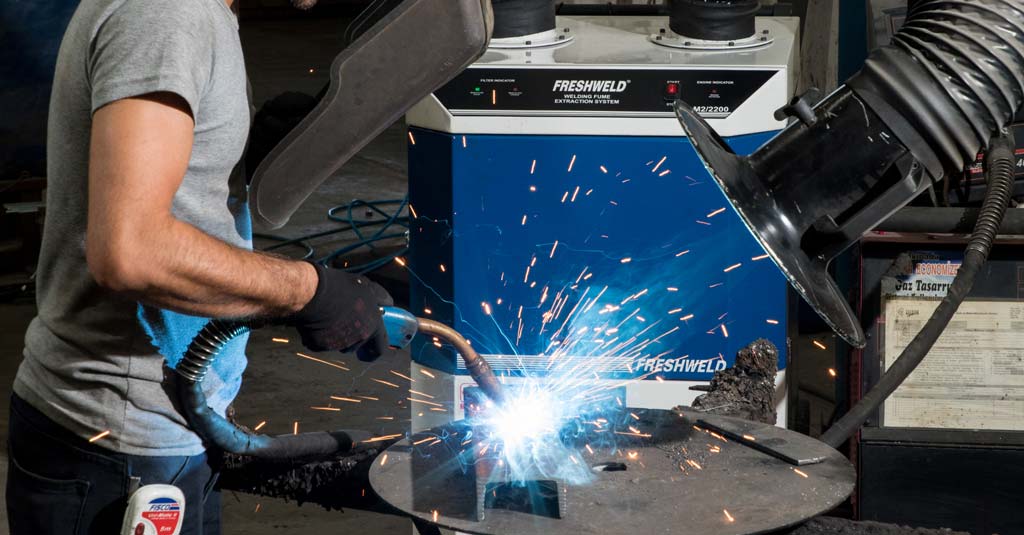
As with all types of steel work, keeping the welding zone clean protects the weld from many potential defects. Ensure that the surface is free from moisture, oil, rust, and paint before welding. The main factors that affect welding efficiency are detailed below.
1. Shielding Gas
The use of shielding gas plays a vital role in achieving better weld quality, minimizing spatter, enabling smoother and faster welding, ensuring arc stability, and reducing both time and labor costs.
For an ideal weld bead, the gas must meet the required specifications, and its selection should depend on the base material, thickness, and welding method. Proper groove design, torch positioning, wire selection, well-maintained equipment, correct parameter setup, and qualified operators are essential to achieving optimal results.
Additionally, efficient removal of welding fumes directly affects productivity.
High-performance fume extraction systems prevent gas accumulation around the arc zone, stabilizing shielding gas flow. This enhances weld quality, maintains clear visibility, and ensures a safer working environment. In contrast, insufficient suction power can cause arc instability, weld defects, and efficiency loss.
If any of these factors are neglected, it becomes difficult to achieve high-quality welds and maintain the desired efficiency levels.
2. Regulator
The regulators attached to gas cylinders must always be in good working condition. A blocked regulator or faulty pressure gauge can prevent the shielding gas from maintaining proper flow rates.
Regular cleaning and maintenance of regulators, selecting models compatible with the gas type, and using leak-proof, high-quality hoses between the regulator and welding machine are critical to achieving consistent gas delivery.
3. Welding Current
Welding current intensity affects melting power and penetration depth.
Excessive current may result in burn-through due to high heat input, while too low a current can cause poor penetration and weld buildup.
4. Welding Wire
Choosing the correct wire diameter enhances both bead quality and penetration.
Although smaller electrodes generally improve penetration, the diameter should be selected according to material thickness, position, melting rate, and penetration requirements. The base metal’s composition must be well understood, and the filler wire should match its properties.
5. Torch
Torch cleanliness and the angle relative to the work surface are key factors for achieving a smooth, defect-free weld. An excessive torch angle can reduce penetration and cause porosity.
If the angle is too steep or the nozzle is clogged, shielding gas coverage decreases. Therefore, the angle should not exceed 30°. The torch should be regularly cleaned, and the cooling system checked for leaks.
Cracks in the cooling circuit may cause porosity and bubble formation in the weld. Additionally, a bent contact tip inside the torch can disrupt wire feed, negatively impacting weld consistency.
In modern welding lines, on-torch fume extraction systems have become increasingly important.
High-suction on-torch fume extractors capture fumes and hazardous particles directly at the source, preventing their release into the air. This not only protects worker health but also helps maintain stable arc performance and consistent weld quality—resulting in both safety and long-term productivity gains.
6. Personnel
Even with the right setup, gas type, and parameters, insufficient operator skill can prevent desired weld quality.
For this reason, welding personnel must undergo certified training and maintain up-to-date qualifications. Periodic hands-on and theoretical training ensures the ongoing improvement of welder proficiency and process consistency.
7. Fume Extraction and Filtration Systems
The 7th and often overlooked factor affecting welding efficiency is the Fume Extraction and Filtration System.
During welding, fumes, metal vapors, and airborne particles not only endanger worker health but can also disrupt arc stability, gas flow, and weld appearance. Therefore, capturing fumes at the source has become essential in modern manufacturing environments.
High-efficiency fume extraction systems remove contaminants directly from the weld zone before they disperse into the air, maintaining indoor air quality and protecting workers. This ensures that both welding stability and operator safety are preserved, while ergonomic mobile or centralized filtration units improve workflow without interrupting production.
Such systems contribute to higher welding productivity and support environmental sustainability in industrial operations.
Welding Efficiency Evaluation
When all components are properly selected and maintained, optimal conditions for high welding efficiency are achieved. However, for both worker and environmental health, it is crucial that the Welding Fume Extraction and Filtration Unit be ergonomic, quiet, and powerful, without disrupting the shielding gas flow or welding arc.
To learn about the 15 key factors to consider when choosing the right Fume Extraction and Filtration Unit, please read our related article:
https://www.freshweld.com.tr/en/article/fume-extraction-buying-guide/
Related article: Personal Protective Equipment Used in Welding Operations
For detailed information and customized solutions, contact our sales representatives today.
Our content emphasizing worker and environmental health is for informational purposes only and is based on research available at the time of publication. For any questions, concerns, diagnoses, or treatment needs related to your health, please consult a physician or a qualified healthcare provider.