
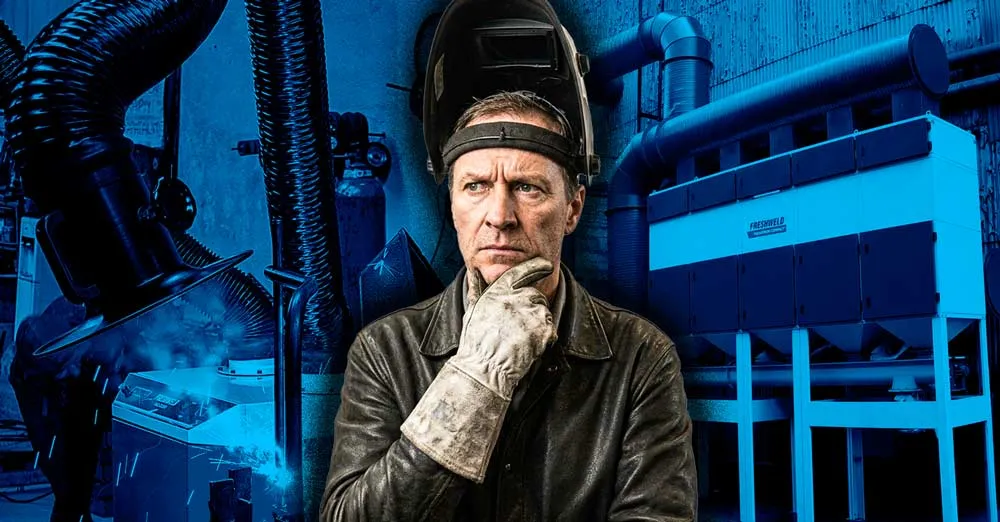
Mobile welding fume extraction units and central filtration systems are not alternatives to one another; they are engineering solutions designed for different production requirements. While mobile systems provide a more flexible and cost-effective solution for single or movable welding stations, central filtration systems can deliver lower operating costs and higher efficiency in production facilities where multiple welders work simultaneously. The right choice should be based on a comprehensive evaluation of production capacity, manufacturing processes, facility layout, and future expansion plans.
What Is the Main Difference Between a Mobile Welding Fume Extractor and a Central Filtration System?
When it comes to welding fume control, one of the most common questions manufacturers ask is:
“Should we invest in a mobile welding fume extractor or install a central filtration system?”
However, the correct answer lies not in the technical specifications of the equipment, but in the structure of the production process itself.
Mobile welding fume extraction units are self-contained systems that combine the extraction arm and filtration unit within a single compact housing. They can be easily moved to the operator’s work area, shared between different welding stations, and commissioned quickly without requiring permanent ductwork. These characteristics make them an ideal solution for maintenance workshops, low-volume manufacturing facilities, and project-based welding applications where flexibility is essential.
Central filtration systems, on the other hand, collect contaminated air from multiple welding stations simultaneously through a shared duct network and transport it to a single filtration unit. This approach simplifies filter management, centralizes maintenance planning, and establishes a more sustainable industrial air filtration infrastructure, particularly in high-volume manufacturing facilities.
For this reason, the real question should be:
Which system best supports my company’s current production requirements and future growth plans?
The answer to this question is one of the most critical factors in ensuring that your investment continues to operate efficiently for many years.
Why Are Mobile Welding Fume Extraction Systems More Advantageous for Independent Welding Stations?
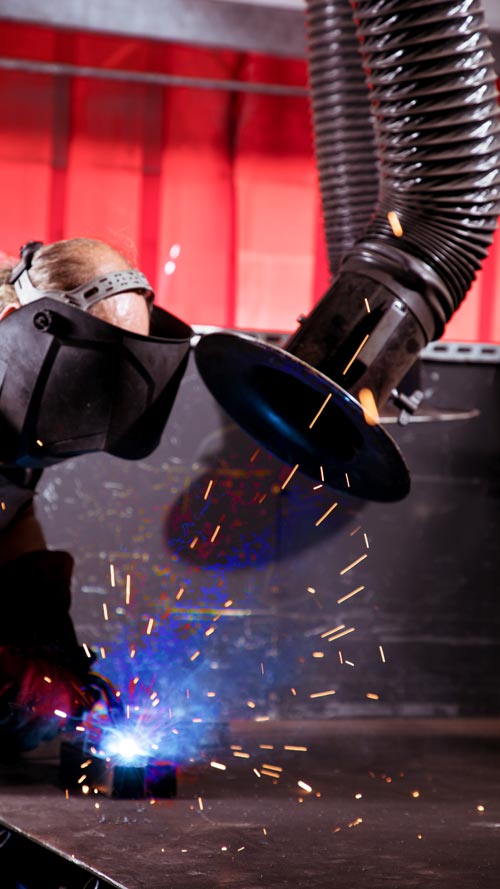
Not every manufacturing facility requires a central filtration system. In operations where only one or two welders work simultaneously, investing in a high-capacity centralized system may result in unnecessary capital expenditure.
Consider a machinery maintenance workshop as an example. Throughout the day, welding tasks are performed on different equipment in various locations. One moment the welder may be repairing a large chassis, and later working inside another production cell. In such environments, a mobile filtration unit that follows the operator provides a far more practical solution than a fixed ducting infrastructure.
FRESHWELD’s MobilEco M1/1100 Mobile Welding Fume Extraction Unit has been specifically developed for single welding stations. With an airflow capacity of approximately 1,100 m³/h, disposable filter technology, and a compact portable design, it minimizes investment costs while maximizing operational flexibility.
For facilities where welding activities are more intensive and production continuously shifts between different workstations throughout the day, the M2 Series Mobile Welding Fume Extraction Units offer higher airflow capacity and greater filtration performance. Their larger filter surface area and multiple extraction arm configurations ensure stable performance during extended production shifts while adapting easily to changing manufacturing requirements.
It is important to remember that selecting a mobile welding fume extraction system should be based not only on the size of the facility but also on the mobility and workflow of welding operations.
For welding areas where two operators work simultaneously, dual-arm extraction units provide an efficient solution. Examples include:
- Dual-arm M2/2200 Series Mobile Welding Fume Extraction Units:
https://www.freshweld.com.tr/en/welding-fume-extractor-cartridge-m2-2200/ - Dual-arm M3/2200 Series Mobile Welding Fume Extraction Units with Activated Carbon Filtration:
https://www.freshweld.com.tr/en/activated-carbon-welding-fume-extraction-m32200/ - For dual-arm models in the M4 and M5 Series, please visit:
https://www.freshweld.com.tr/en/mobile-welding-fume-extractors/
When Does a Central Filtration System Provide a Real Advantage?
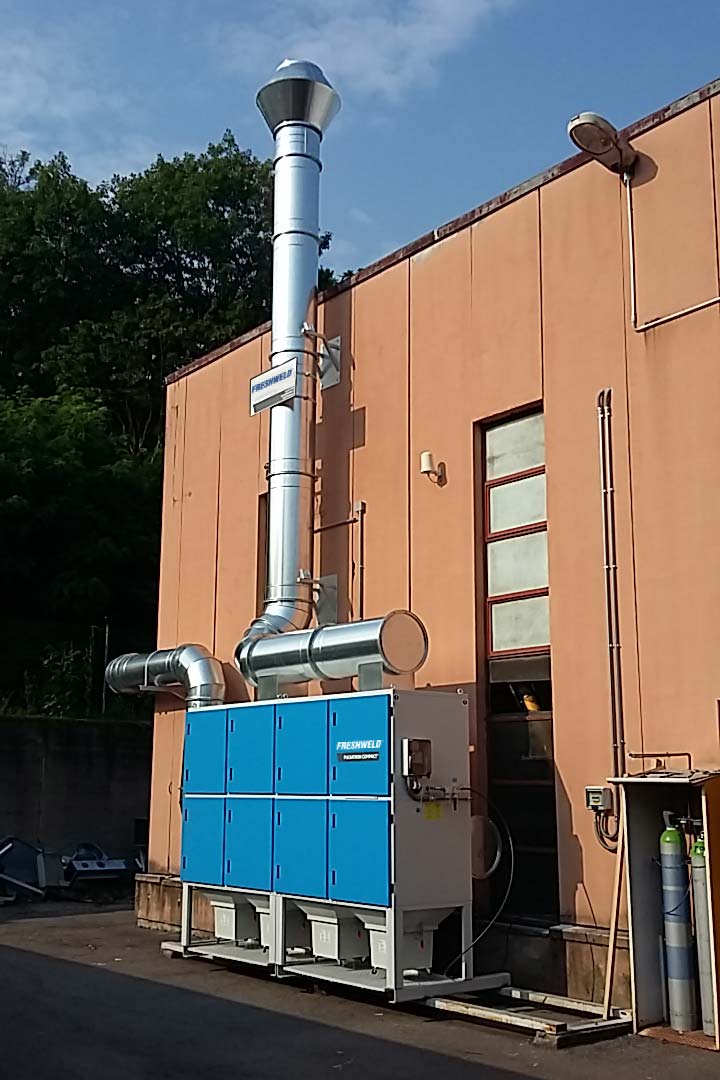
While mobile welding fume extraction systems offer highly effective solutions for specific applications, production requirements evolve as manufacturing capacity increases. In facilities where numerous welding operations are performed simultaneously, installing an individual mobile extractor at every workstation may initially appear practical. However, over the long term, this approach can lead to higher maintenance requirements, more complex filter management, and increased energy consumption.
Industries such as automotive manufacturing, heavy steel fabrication, pressure vessel production, shipbuilding, and the defense industry often operate dozens of welding stations at the same time. In these environments, connecting all extraction points to a shared duct network and a single central filtration unit provides a significantly more sustainable and efficient solution than operating separate extraction units for each welder.
The primary advantage of a central filtration system is not simply its higher airflow capacity. Its greatest benefit is the ability to manage the facility’s entire air filtration infrastructure from one centralized location.
- Filtration management is centralized across the entire facility.
- Filter replacement schedules can be planned from a single location.
- Maintenance activities become easier to organize and monitor.
- Additional extraction points can be integrated with minimal disruption as production expands.
FRESHWELD’s central cartridge filtration systems are engineered with a modular architecture specifically for these demanding industrial applications. Depending on production capacity, they can be configured with different filter surface areas, airflow capacities, and fan arrangements, allowing the system to support both today’s manufacturing requirements and future production expansion plans.
To explore our Central Filtration Systems, please visit:
https://www.freshweld.com.tr/en/central-filtration-systems/
Technical Note
The performance of a welding fume extraction system depends on far more than its filtration capacity alone. Effective fume control is achieved by evaluating extraction point positioning, airflow requirements, duct design, welding processes, and the facility’s future expansion plans as a complete engineering solution. For this reason, the decision between a mobile extraction unit and a central filtration system should focus not only on the initial investment cost, but also on the long-term operational efficiency the system will deliver throughout its service life.
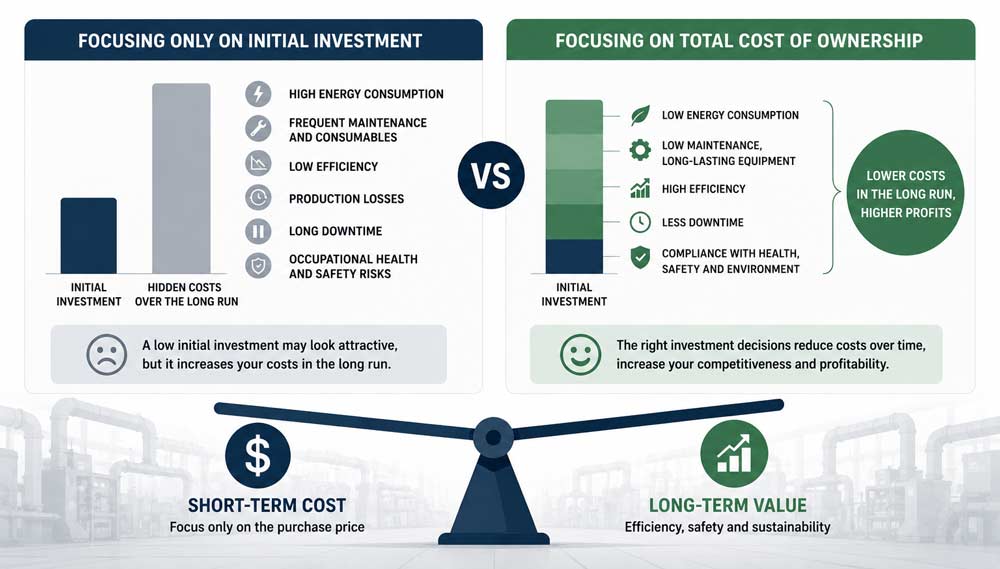
Focus on Total Cost of Ownership Instead of Initial Investment Cost
One of the most common mistakes when investing in a welding fume extraction system is making the decision based solely on the initial purchase price.
In reality, a filtration system is a long-term industrial investment expected to operate reliably for many years. Therefore, the purchase price represents only one part of the overall cost. Energy consumption, filter replacement frequency, maintenance requirements, production downtime, and future capacity expansion all contribute significantly to the total cost of ownership.
Let’s look at a simple example.
A company may initially purchase mobile extraction units for two welding stations. However, if production capacity doubles within a year, the same facility may need to purchase four additional mobile units. At the same time, electrical infrastructure, spare filter inventory, and maintenance planning requirements will also increase.
By comparison, a properly designed modular central filtration system installed from the beginning can often accommodate additional welding stations with substantially lower expansion costs.
For this reason, the following questions should always be considered during the investment evaluation process.
| Evaluation Criteria | Mobile Extraction System | Central Filtration System |
|---|---|---|
| Do welding locations change frequently? | ✔ Better suited | ✖ |
| Are multiple welders working simultaneously? | Limited suitability | ✔ Better suited |
| Is future production expansion planned? | Limited scalability | ✔ Modular and easily expandable |
| Can ductwork be installed? | Not required | Required |
| Is centralized maintenance management preferred? | ✖ | ✔ Ideal solution |
The comparison clearly shows that neither solution is universally superior under every condition. The most appropriate choice depends entirely on the production characteristics of the facility.
What Should Companies Planning Future Growth Do Today?
For newly established manufacturers and rapidly growing production facilities, the most effective approach is to plan not only for today’s operational requirements but also for future manufacturing objectives.
For example, if a company currently operates four welding stations but plans to invest in robotic welding cells within the next two years, its air filtration infrastructure should already be designed to accommodate that transformation. Likewise, if new production halls, additional welding booths, or automation projects are part of the company’s roadmap, selecting a filtration system that can be expanded easily becomes a significant long-term advantage.
Many manufacturers prefer to manage this transition gradually. Mobile welding fume extraction units can initially be used in maintenance workshops and low-volume production areas, while central filtration systems are installed for high-volume manufacturing lines. This phased investment strategy allows companies to expand their filtration infrastructure in parallel with production growth instead of making a single large investment upfront.
FRESHWELD’s product portfolio includes both mobile welding fume extraction units and modular central filtration systems, making it possible to develop hybrid solutions tailored to different production environments. It is common, for example, to use the MobilEco M1 Series in maintenance workshops while a central filtration system serves the primary production line within the same facility.
This approach not only addresses current operational needs but also creates a scalable infrastructure capable of supporting future investments more efficiently.
Conclusion: The Best Investment Is Not the Largest System, It’s the Right System
Choosing between a mobile welding fume extractor and a central filtration system is far more than a simple equipment selection. It is a strategic investment that directly influences production efficiency, employee exposure, maintenance requirements, and the long-term growth potential of the business.
A mobile filtration unit may be the ideal solution for a maintenance workshop with a single welding station, while the same solution could prove inadequate in a high-volume production facility where dozens of welders operate simultaneously. Likewise, a filtration system designed solely around today’s production requirements may require substantial reinvestment within only a few years as manufacturing capacity expands.
For this reason, selecting the right solution should begin not with choosing equipment, but with analyzing the production process itself. When welding methods, the number of operators, shift schedules, workstation layouts, and future production targets are evaluated together, it becomes much easier to identify the filtration solution that will deliver the greatest long-term value.
A properly engineered welding fume extraction system does far more than protect employee health. It contributes to production continuity, reduces maintenance costs, improves operational efficiency, and establishes a sustainable infrastructure capable of supporting future facility expansion.
At FRESHWELD, our mobile welding fume extraction units, central filtration systems, robotic welding extraction hoods, and process-specific industrial filtration solutions are engineered to meet the unique requirements of different manufacturing environments. Because every facility has different operational needs, the right solution is determined through engineering analysis rather than by selecting a standard product.
Contact Our Technical Team and Let's Choose the Right Product TogetherTechnical Evaluation
Mobile welding fume extraction units and central filtration systems should not be viewed as competing alternatives. In many manufacturing facilities, both solutions operate together to address different production requirements. Mobile filtration systems provide exceptional flexibility in maintenance workshops and temporary welding areas, while central filtration systems offer superior efficiency for high-volume production lines. Therefore, investment decisions should focus not only on the initial purchase price but also on total cost of ownership, future production plans, operational efficiency, and the specific requirements of each manufacturing process.
Frequently Asked Questions
How many welders can a mobile welding fume extraction unit serve?
There is no universal answer. The appropriate capacity depends on several factors, including the welding process, operating time, fume generation rate, and required airflow. Mobile extraction units are generally sufficient for single or low-intensity welding stations, whereas central filtration systems become more suitable when multiple welders operate simultaneously.
Is a central filtration system always the more economical option?
No. For small-scale production or mobile welding applications, portable extraction units often require a lower initial investment. The advantages of central filtration systems become more apparent in facilities with high production volumes, where centralized maintenance and scalability significantly reduce long-term operating costs.
Can mobile extraction units and central filtration systems be used together in the same factory?
Yes. This is a common practice in modern manufacturing facilities. A central filtration system may serve the primary production line, while mobile welding fume extractors are used in maintenance workshops, repair areas, or temporary welding stations.
Can mobile welding fume extraction units be used in robotic welding applications?
Although they may be suitable for certain applications, robotic welding cells generally achieve better and more consistent extraction performance with fixed extraction hoods connected to central filtration systems. An extraction system specifically engineered for the geometry of the robotic cell also contributes to improved process efficiency.
Is airflow capacity the only factor to consider when selecting a filtration system?
No. Airflow is an important design parameter, but it should never be considered in isolation. Extraction hood design, ductwork layout, filtration technology, ease of maintenance, welding processes, and future production requirements should all be evaluated together to achieve optimal performance.