
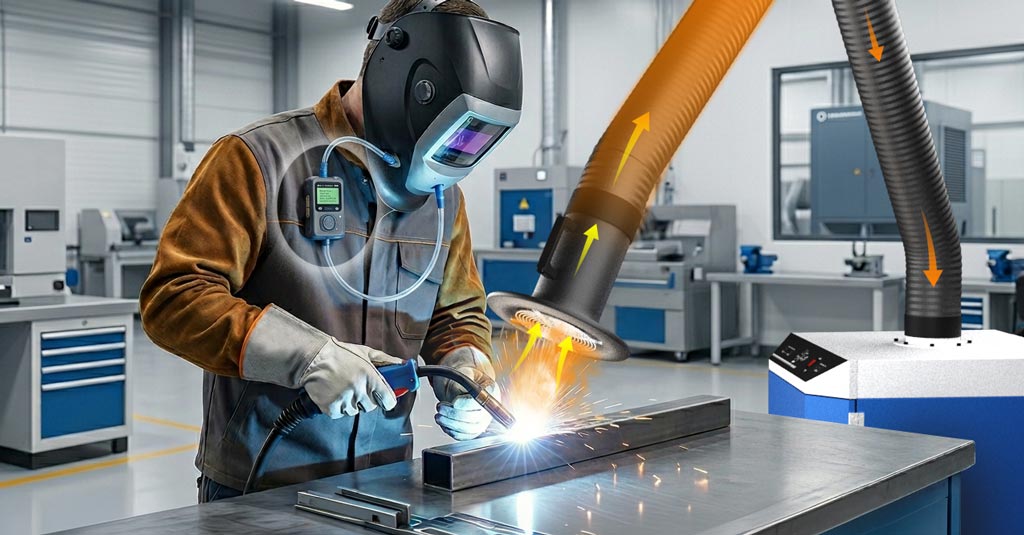
Welding fume exposure is one of the most important occupational health concerns in fabrication shops, manufacturing facilities, shipyards, and metalworking environments. During welding operations, metal particles, gases, and chemical compounds are released into the air, creating potential risks for workers if exposure is not properly controlled.
Regular welding fume exposure assessment helps employers understand actual workplace conditions, verify compliance with occupational safety regulations, and evaluate the effectiveness of ventilation and filtration systems. Measuring exposure levels is often the first step toward improving workplace air quality and protecting employees from long-term health risks.
What Is Welding Fume Exposure?
The composition of welding fumes depends on several factors, including the welding process, base materials, workplace industrial ventilation systems, and the effectiveness of welding fume extraction systems. Welding fume exposure occurs when workers inhale airborne contaminants generated during welding, cutting, brazing, or related thermal processes. High temperatures vaporize metals, welding consumables, coatings, and other materials. As these vapors cool, they form extremely fine particles that remain suspended in the air.
The composition of welding fumes depends on several factors, including:
- The welding process being used
- The base material and filler metal
- Protective coatings and surface contaminants
- Shielding gases
- Ventilation conditions
- The effectiveness of welding fume extraction systems
Visible smoke is not always an accurate indicator of exposure. Even when fumes appear minimal, hazardous respirable particles and gases may still be present within the worker’s breathing zone.
Why Is Welding Fume Exposure Measurement Important?
Monitoring welding fume exposure is essential for protecting worker health and reducing the risk of occupational diseases.. Exposure measurements provide objective data that can be used to identify hazards and prioritize corrective actions.
Many facilities already operate ventilation systems or fume extraction equipment. However, system performance may deteriorate over time due to clogged filters, improper extraction arm positioning, insufficient airflow, or inadequate maintenance. Without measurement data, these issues often go unnoticed.
Welding fume monitoring helps organizations:
- Determine actual worker exposure levels
- Evaluate workplace health and safety risks
- Verify compliance with exposure limits
- Assess ventilation and filtration effectiveness
- Support occupational hygiene programs
- Provide documentation during audits and inspections
- Guide future safety and engineering investments
How Is Welding Fume Exposure Measured?
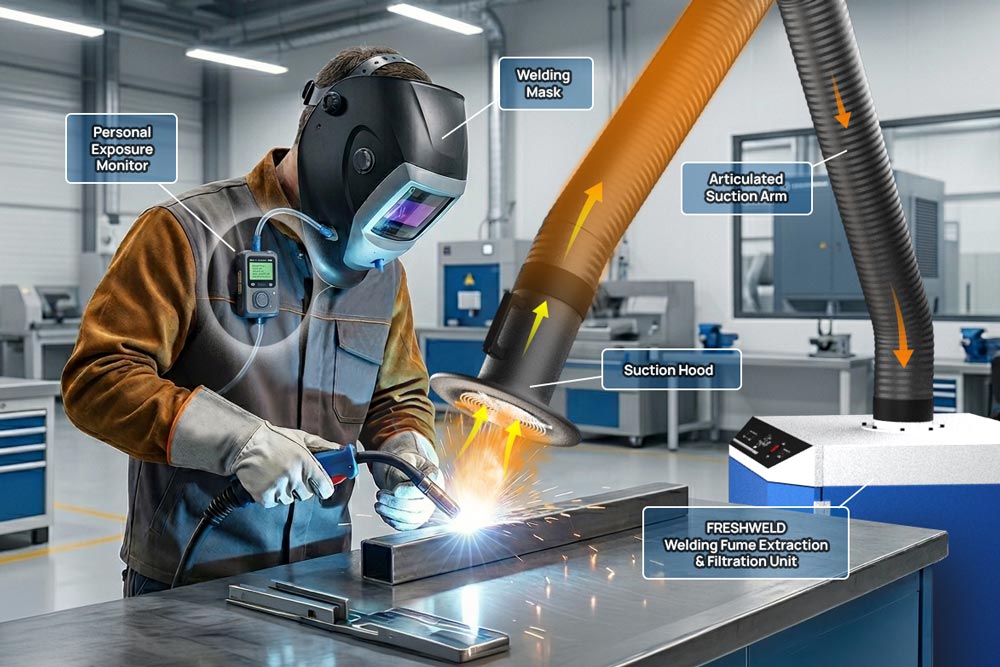
The most reliable method for assessing welding fume exposure is personal exposure monitoring. Additional information can be obtained through workplace air quality measurements, particulate sampling, and gas monitoring.
Personal Exposure Monitoring
 Personal exposure monitoring measures contaminants directly within a worker’s breathing zone. Sampling equipment is attached near the employee and collects air throughout the work shift. The collected samples are analyzed in a laboratory to determine the worker’s average exposure level.
Because this method reflects actual working conditions, it is generally considered the most accurate approach for evaluating welding fume exposure.
Workplace Air Quality Monitoring
 Area air monitoring evaluates general air quality throughout a welding workshop or production facility. Monitoring devices are placed at selected locations to measure airborne particle concentrations and gas levels.
This approach helps identify high-risk zones, evaluate ventilation performance, and compare air quality across different production areas. However, area measurements should not replace personal exposure assessments when worker exposure data is required.
Particulate Measurements
Welding fumes primarily consist of fine airborne metal particles. Common measurement parameters include:
- Total airborne dust
- Respirable dust
- Fine particulate matter
- Metal-specific contaminant concentrations
Respirable particles are particularly important because they can penetrate deep into the lungs and contribute to long-term respiratory health issues.
Gas Monitoring
Certain welding processes generate hazardous gases that should be monitored, especially in enclosed or poorly ventilated spaces.
Common gases include:
- Ozone (O₃)
- Nitrogen Oxides (NOx)
- Carbon Monoxide (CO)
- Carbon Dioxide (CO₂)
- Other process-generated gases
Gas monitoring may be performed using portable instruments or fixed continuous monitoring systems.
Common Welding Fume Contaminants
The specific substances measured during welding fume analysis depend on the materials and consumables involved. Common contaminants include:
Manganese
Manganese is widely used in welding consumables and can be present in significant concentrations within welding fumes. Long-term exposure may affect worker health, making routine monitoring important in high-production welding environments.
For additional information about controlling manganese exposure, read our guide: https://www.freshweld.com.tr/en/article/reduce-welder-manganese-exposure/
Hexavalent Chromium (Cr VI)
Welding stainless steel can generate hexavalent chromium compounds, which are classified as highly hazardous substances. Exposure monitoring and control measures should be prioritized whenever stainless steel welding is performed.
Nickel Compounds
Nickel-containing fumes may be generated during stainless steel and alloy welding operations. Effective local exhaust ventilation helps minimize worker exposure.
Iron Oxide and Other Metal Oxides
Carbon steel welding commonly produces iron oxide particles. Depending on the materials involved, additional contaminants may include aluminum oxide, zinc oxide, copper oxide, and other metal compounds.
Understanding Welding Fume Exposure Limits
Occupational exposure limits establish the maximum concentration of hazardous substances that workers can be exposed to during a specified time period. These limits vary depending on the substance and applicable regulations.
Exposure assessments typically consider:
- 8-hour time-weighted average (TWA) exposure values
- Short-term exposure limits (STEL)
- Chemical hazard classifications
- Toxicological characteristics
- Potential carcinogenicity
- Work schedules and shift durations
- Existing control measures
Because welding fumes consist of multiple contaminants, evaluation should focus on individual hazardous substances rather than treating welding fumes as a single contaminant.
What Should Be Done If Exposure Levels Are Too High?
If measurement results exceed acceptable levels, corrective actions should focus on controlling contaminants as close to the source as possible.
Use Source Capture Fume Extraction
Capturing welding fumes directly at the source is the most effective engineering control strategy. Properly positioned extraction arms can remove contaminants before they reach the worker’s breathing zone.
Evaluate Centralized Filtration Systems
Facilities with multiple welding stations may benefit from centralized filtration systems that collect and filter contaminated air from multiple work areas through a common filtration unit.
Maintain Filters and Equipment
Filter loading, airflow restrictions, fan degradation, and duct contamination can significantly reduce extraction efficiency. Routine inspections and preventive maintenance programs are essential.
Train Operators
Even well-designed systems require proper use. Workers should be trained to correctly position extraction arms and consistently use available control equipment during welding operations.
Pre-Assessment Inspection Checklist
Before conducting welding fume measurements, several factors should be reviewed to ensure accurate results:
- Are filtration systems operating correctly?
- Is airflow sufficient?
- Are extraction arms positioned properly?
- Is general ventilation functioning effectively?
- Are operators consistently using extraction equipment?
- Are welding materials and consumables documented?
- Is monitoring being conducted under actual production conditions?
These checks help identify potential causes of elevated exposure and improve interpretation of monitoring results.
For additional guidance on welding fume compliance and workplace inspections, read:
Avoid Penalties Caused by Welding Fumes and Gases
How Can FRESHWELD Help?
FRESHWELD provides specialized solutions for welding fume control, industrial air filtration, and workplace air quality improvement. Through local exhaust ventilation systems, centralized filtration units, and application-specific engineering solutions, facilities can significantly reduce worker exposure and improve environmental conditions.
Measuring welding fume exposure is an important first step, but effective control requires properly designed extraction and filtration systems. FRESHWELD helps manufacturers identify suitable solutions that improve air quality, support regulatory compliance, and protect employee health.
Contact Our Technical Team and Let's Choose the Right Product TogetherFrequently Asked Questions
Is welding fume measurement required?
Employers are responsible for evaluating worker exposure to hazardous substances and implementing appropriate controls. Welding fumes are commonly included within occupational exposure assessment programs.
What is the most accurate welding fume measurement method?
Personal exposure monitoring is generally considered the most reliable method because it measures contaminants directly within the worker’s breathing zone.
Is general ventilation sufficient for welding fumes?
General ventilation can support air quality improvement, but source capture through local exhaust ventilation is typically the most effective control method.
Which substances present the highest risks in welding fumes?
Manganese, hexavalent chromium, nickel compounds, and fine metal particles are among the most frequently monitored contaminants.
What should be checked first if exposure levels are high?
Ventilation systems, extraction equipment, airflow rates, filter condition, extraction arm positioning, and operator practices should all be evaluated before implementing corrective measures.
Sources
- OSHA – Welding, Cutting and Brazing
https://www.osha.gov/welding-cutting-brazing - NIOSH – Welding Safety and Health Topics
https://www.cdc.gov/niosh/welding/about/ - American Welding Society (AWS) – Welding Safety Resources
https://www.aws.org - EU-OSHA – Dangerous Substances
https://osha.europa.eu/en/themes/dangerous-substances - Republic of Türkiye Ministry of Labor and Social Security – Chemical Agents Regulation
https://www.csgb.gov.tr