
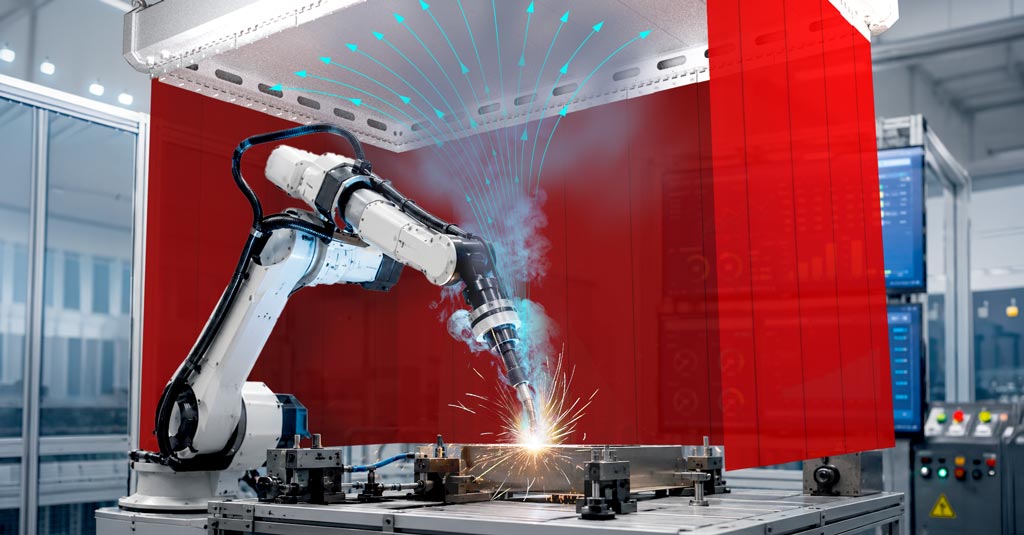
In industrial production, robotic welding systems have become a core component of many manufacturing strategies thanks to their high speed, repeatable quality, and productivity advantages. However, robotic welding fumes generated during robotic welding applications are an important factor that can affect not only the working environment but also equipment performance and production continuity. Achieving the expected performance from robot investments does not depend solely on robot selection or the level of automation. If fumes and fine metal particles generated during the welding process are not controlled, they can gradually turn into a serious problem that increases maintenance costs and negatively affects production continuity.
The Maintenance 4.0 approach aims to predict failures before they occur by continuously monitoring equipment condition in line with Industry 4.0 principles. Within this approach, welding fume management should be evaluated not only from the perspective of occupational health and safety, but also in terms of production efficiency, equipment lifetime, and total cost of ownership.
How can maintenance costs be reduced in robotic welding?
Short Answer: The most effective ways to reduce maintenance costs in robotic welding cells are to capture welding fumes at the source, use the correct robotic extraction hood system, select filtration technology suitable for the process, and regularly monitor filter performance. This approach reduces equipment contamination, helps prevent unplanned downtime, and supports production continuity.
Why Do Welding Fumes Become a Maintenance Problem in Robotic Welding Cells?
Welding fumes generated in robotic welding applications do not only affect the air quality of the working environment. Fine metal particles contained in the fumes can settle on equipment inside the robotic cell over time and increase maintenance requirements.
Especially in high-volume production facilities, welding fumes can directly affect the following equipment:
- Robot arms and motion mechanisms
- Welding torches
- Optical sensors and detection systems
- Camera systems
- Cable carrier chains
- Fixtures and positioning equipment
- Electrical panels and automation components
This contamination can eventually lead to reduced sensor sensitivity, decreased equipment performance, and more frequent maintenance requirements. In robotic systems in particular, even small performance losses can directly affect production efficiency.
The Impact of Unplanned Downtime on the Return on Robot Investment
Robotic welding systems are generally preferred to increase production capacity and standardize quality. However, unplanned downtime is one of the major cost factors that can extend the payback period of these investments.
Unplanned downtime in a robotic welding cell is not limited to maintenance costs alone. It can also bring indirect costs such as:
- Production loss
- Order delivery delays
- Operator waiting time
- Quality problems
- Need for overtime
- Spare parts costs
For this reason, many manufacturers today focus not only on robot performance but also on environmental factors that affect maintenance processes in order to improve OEE (Overall Equipment Effectiveness) values.
The Importance of Welding Fume Management in the Maintenance 4.0 Approach
Maintenance 4.0 is a modern maintenance approach that aims to take preventive action before failures occur by analyzing the operating condition of equipment. Sensor technologies, data analytics, and predictive maintenance applications are the core components of this approach.
However, monitoring equipment data alone is not enough for maintenance processes to succeed. The environmental conditions in which the equipment operates must also be kept under control.
Effective welding fume management can help:
- Reduce equipment contamination.
- Optimize maintenance intervals.
- Reduce the risk of unplanned downtime.
- Manage filter performance more efficiently.
- Increase the availability rate of robot investments.
For this reason, welding fume management is considered not only a ventilation issue in modern manufacturing facilities, but also an important part of the maintenance strategy.
How Do Robotic Extraction Hood Systems Reduce Maintenance and Cleaning Needs?
Correctly designed extraction systems are required to capture fumes generated in robotic welding cells before they spread into the surrounding environment. At this point, robotic extraction hood systems play a critical role.
Robotic extraction hoods capture welding fumes at the source and direct them to the filtration system. This significantly reduces the circulation of fumes inside the robotic cell and their accumulation on equipment.
With a correctly designed system:
- The robotic cell remains cleaner.
- The contamination rate of equipment decreases.
- Cleaning operations become less frequent.
- Maintenance times are shortened.
- The efficiency of filtration systems increases.
Especially extraction hood systems engineered according to the robot’s movement area can increase extraction performance while operating without interfering with production processes.
The Impact of Long-Life Disposable Filters on Downtime
Keeping maintenance times short is highly important in facilities with intensive production. For this reason, many businesses look for solutions that simplify filter maintenance operations.
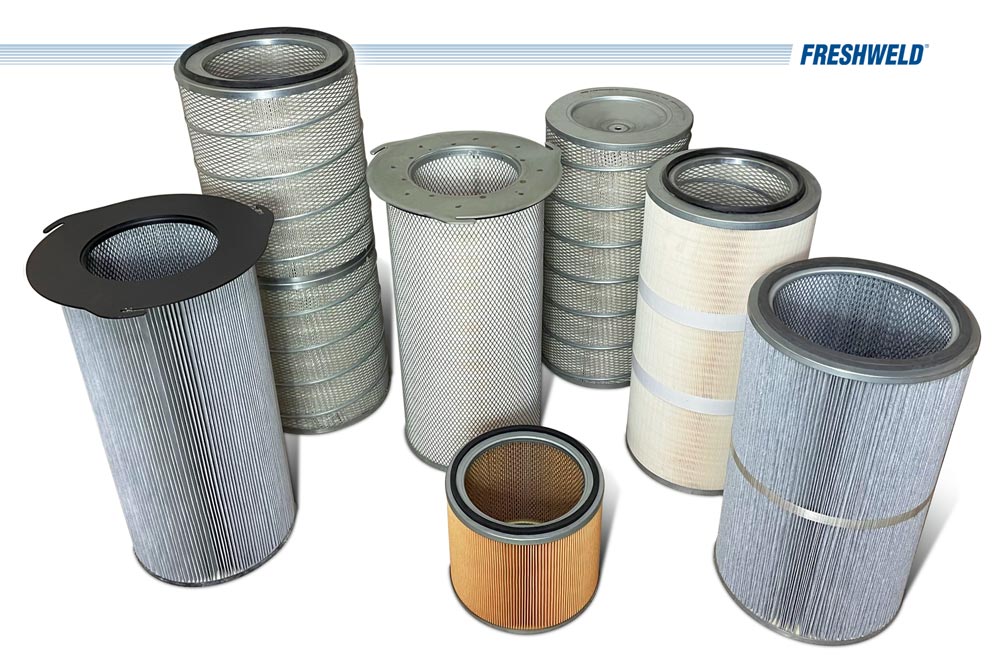
Long-life disposable filter technologies can provide the following advantages:
- Fast filter replacement
- Lower maintenance time
- Less labor requirement
- Easier planned maintenance processes
- Faster restart of production
Especially in robotic welding applications with high production intensity, short filter replacement times can help reduce total downtime costs.
Total Cost of Ownership (TCO) Advantage with Cleanable Filters
In filtration systems, not only the initial investment cost but also the costs generated throughout the entire life cycle of the system should be evaluated.
Cleanable filter technologies can contribute to lower operating costs by reducing filter consumption in suitable applications.
Advantages of Cleanable Filters
- Lower filter consumption
- Reduced consumable material costs
- A more sustainable operating model
- Long-term cost advantage
- Performance tracking compatible with Maintenance 4.0 applications
To select the right filter technology, the welding method, fume quantity, operating time, maintenance strategy, and annual operating costs should be evaluated together.
Disposable Filter or Cleanable Filter?
| Feature | Long-Life Disposable Filter | Cleanable Filter |
|---|---|---|
| Maintenance Time | Shorter | Longer |
| Filter Consumption | Higher | Lower |
| Labor Requirement | Low | Medium |
| Long-Term Operating Cost | Depends on the process | Can provide an advantage |
| High-Intensity Production Lines | Highly suitable | Application-dependent |
Filter Selection Criteria for Robotic Welding Cells
Each robotic welding application generates different amounts of fumes and particles. Therefore, filter selection should be based on engineering calculations rather than a standard approach.
The following criteria should be considered when selecting a filter:
- Welding method
- Daily operating time
- Number of shifts
- Fume intensity
- Energy consumption targets
- Maintenance strategy
- Total cost of ownership expectations
- Future capacity expansion plans
Correct filter selection not only improves air quality but also contributes to reducing maintenance costs and downtime.
Conclusion and Evaluation
The Hidden Factor That Improves Robot Investment Efficiency Is the Filtration System
While robotic welding systems deliver high production performance, ineffective welding fume management can lead to increased maintenance costs and more unplanned downtime.
Within the Maintenance 4.0 approach, welding fume control is an important application that contributes to extending equipment lifetime, optimizing maintenance processes, and protecting production continuity.
FRESHWELD robotic extraction hood systems, together with long-life disposable filter and cleanable filter solutions, help create cleaner working conditions in robotic welding cells, simplify maintenance operations, and improve production efficiency.
To determine the most suitable extraction hood and filtration solution for your robotic welding cells, you can contact FRESHWELD experts and receive process-specific engineering support.
Contact Our Technical Team and Let's Choose the Right Product TogetherFrequently Asked Questions
Why should welding fumes be controlled in robotic welding cells?
Welding fumes can cause equipment contamination, increased maintenance frequency, and a higher risk of unplanned downtime.
What is the relationship between Maintenance 4.0 and welding fume management?
The Maintenance 4.0 approach aims to protect equipment performance. Controlling welding fumes is one of the important applications that supports this goal.
Should a disposable filter or a cleanable filter be preferred?
This choice should be determined according to the welding process, maintenance strategy, and total operating costs. A technical evaluation is recommended for each application.
Do robotic extraction hood systems affect production efficiency?
Correctly designed extraction hood systems can reduce equipment contamination, shorten maintenance times, and help lower the risk of unplanned downtime.
Sources
- EU-OSHA – Maintenance and Occupational Safety
https://osha.europa.eu/en/themes/…/maintenance-and-occupational-safety-and-health-statistical-picture
- OSHA – Welding, Cutting and Brazing
https://www.osha.gov/welding-cutting-brazing
- NIOSH – Welding Safety and Health Topics
https://www.cdc.gov/niosh/welding/about/
- International Federation of Robotics (IFR)https://ifr.org