
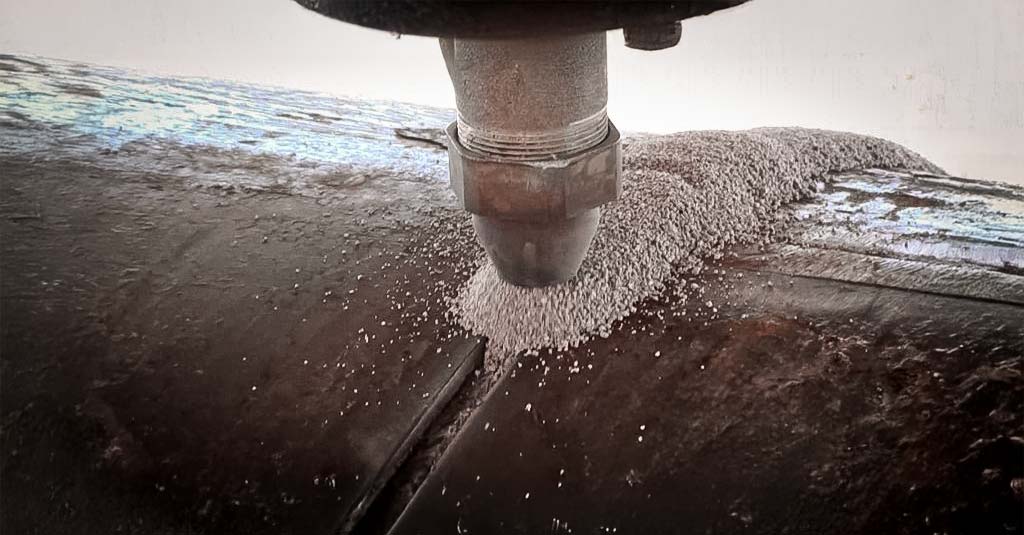
The Submerged Arc Welding (SAW) process delivers high weld quality and a smooth, consistent bead appearance while remaining cost-effective in terms of materials and labor. It is widely used in heavy industry, steel construction, shipbuilding, pressure vessel fabrication, and pipeline manufacturing.
Basic Principle of Submerged Arc Welding
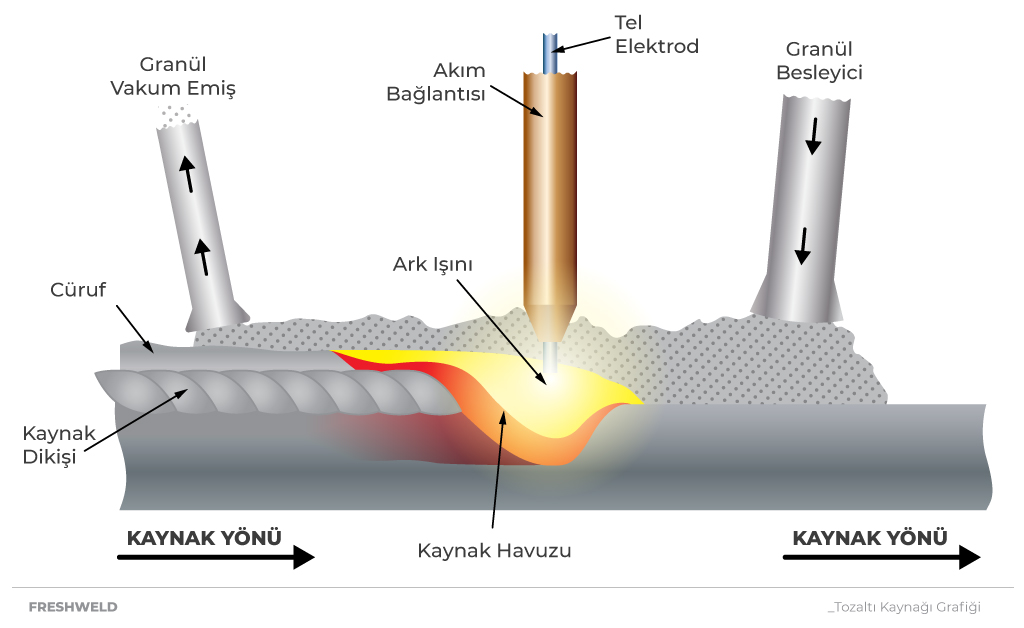
In this method, the welding arc is formed between a bare electrode wire and the workpiece. The arc area is completely covered by a layer of granular welding flux fed from a separate channel.
The term “Submerged Arc Welding” derives from the fact that the arc occurs beneath a layer of flux.
When parameters such as welding current, voltage, wire feed speed, and welding travel speed are correctly adjusted, the process delivers defect-free, aesthetically pleasing, and high-strength welds.
Key Advantages of Submerged Arc Welding
- High welding speed increases overall production efficiency.
- The flux layer shields the arc light, eliminating the need for additional eye protection.
- No spatter loss occurs during welding.
- Deep weld penetration and narrow grooves reduce both labor and material costs.
- Alloyed fluxes allow precise adjustment of weld characteristics.
- Compatible with semi-automatic, fully automatic, and manual systems.
- Can be easily adapted for gas-shielded welding with minor adjustments.
- Ideal for production lines requiring high quality, consistency, and repeatability.
Fume and Dust Emissions in Submerged Arc Welding
Although SAW is considered a cleaner process in terms of visible fume generation, heated flux and vaporized metal can release fine particles, metal oxide fumes, and micro dust into the air.
These emissions particularly arise from:
- Flux recovery systems,
- Flux feeding units,
- Enclosed welding cabins where air circulation is limited.
Over time, these particles can degrade indoor air quality and pose occupational health risks. Therefore, even in SAW operations, welding fume extraction and filtration systems play a vital role.
The Importance of Fume Extraction and Filtration Systems
Local extraction units and centralized filtration systems used in SAW lines capture airborne dust and metallic particles, ensuring a safer and healthier working environment.
These systems:
- Extract flux dust,
- Filter metal oxide fumes,
- Remove welding gases and residual particulates — protecting worker health and maintaining air quality standards.
FRESHWELD® designs and manufactures industrial fume extraction and filtration systems engineered for high-efficiency particle filtration and low-noise operation. These systems enable production facilities to maintain welding quality while safeguarding clean air standards.
Conclusion
The Submerged Arc Welding process has earned a strong position in the industry thanks to its high speed, low cost, and superior weld quality.
However, the fine flux dust and metallic particles generated during production must be effectively controlled using well-designed fume extraction and filtration systems to prevent long-term health and environmental hazards.
Thus, maintaining welding quality and ensuring sustainable air cleanliness should remain top priorities for all modern production facilities.