
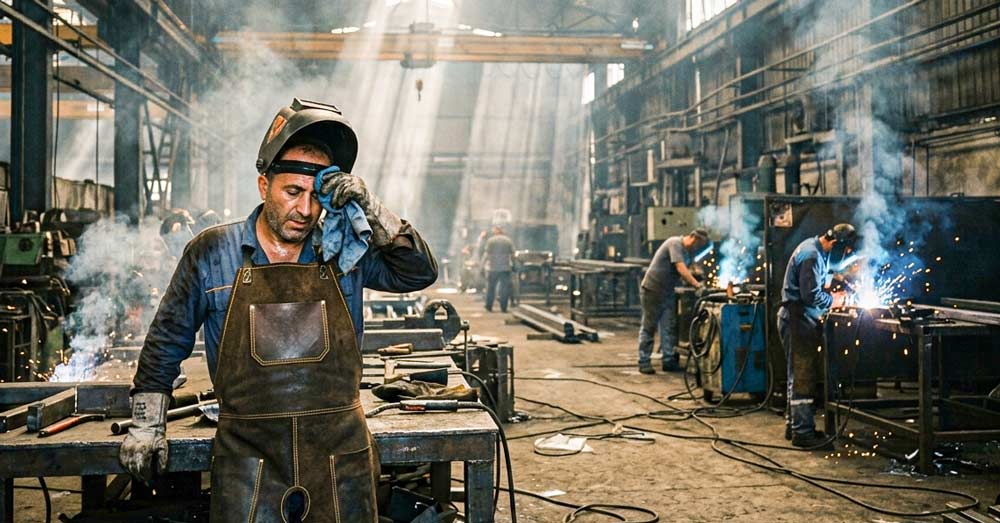
Industry Insight: Rising temperatures are no longer a seasonal issue that only affects worker comfort in industrial manufacturing. During hot weather, factory air quality and indoor temperature conditions can directly influence employee health, production continuity, energy consumption, equipment performance, and overall indoor air quality.
The summer of 2026 has started with heatwaves affecting Europe and surrounding regions. High temperatures are no longer a concern only for outdoor workers; they have become an operational risk that must also be managed carefully in enclosed manufacturing facilities, welding workshops, metalworking areas, laser processing zones, assembly lines, and heavy industrial plants.
For production managers, HSE teams, and technical maintenance departments, temperature management should be evaluated together with air conditioning, industrial ventilation, energy efficiency, and the control of process-related pollutants. When temperature rises, it is not only the ambient air that becomes warmer; worker fatigue, fan and ventilation loads, filter maintenance requirements, and welding fume or dust control also become more critical.
You can explore more details in our article titled Clean Air Quality and Ventilation.
Why has temperature become a strategic issue in industrial manufacturing?
In industrial manufacturing, temperature affects not only employee health and productivity but also production continuity, energy costs, and factory air quality. For this reason, temperature management should not be considered only as a comfort-related air conditioning issue; it should be part of production planning and HSE strategy.
In the past, summer temperature increases were often seen by many businesses as a temporary seasonal problem. However, longer heatwaves, insufficient night-time cooling, and the inability to remove accumulated heat from enclosed production areas have turned this issue into a more permanent management topic.
In metalworking, welded fabrication, machining, laser cutting, grinding, foundry operations, press lines, and heavy industry applications, production environments already generate a high internal heat load independently of outdoor temperature. When summer heat is added to this existing process load, indoor conditions may reach levels that affect worker performance and process reliability.
Why can factory interiors become hotter than the outdoor environment?
Factory interiors may become hotter than the outdoor environment due to roof surfaces, machinery, welding and cutting processes, motors, compressors, furnaces, insufficient air exchange, and solar heat gain. This effect becomes especially noticeable in large-volume production areas where airflow has not been properly planned.
Temperature inside a manufacturing facility is not determined only by weather conditions. Operating equipment, production processes, and building architecture all contribute to the total heat load. Large metal roofs absorb solar radiation throughout the day, high-power machines continuously generate heat, and welding or cutting operations create local temperature increases.
If air movement is weak in enclosed spaces, hot air may accumulate near the ceiling, while at working level a heavier environment mixed with pollutants may form. Therefore, simply opening doors and windows or using general fans to circulate air is not always sufficient. The direction of airflow, the source of pollutants, worker positioning, and the type of process should all be evaluated together.
How does high temperature affect worker performance?
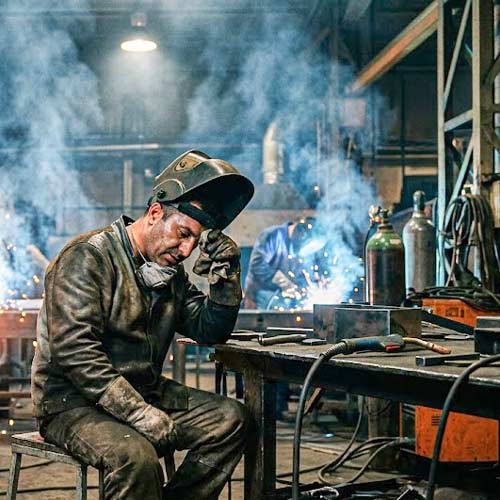
High temperature can lead to fatigue, reduced attention, slower reaction time, and increased physical strain among workers. These effects may indirectly influence production speed, safety awareness, quality control attention, and shift efficiency.
Many tasks in industrial manufacturing require focus, coordination, and continuity. Welding operators, grinding workers, quality control personnel, maintenance teams, and line operators often work while using personal protective equipment. This equipment is essential for safety; however, in hot environments, it may make it more difficult for the body to regulate heat.
Heat stress should not be considered only as an acute health problem that occurs under extreme temperature conditions. Moderate but prolonged heat exposure can also affect worker comfort, attention level, and production rhythm. For this reason, HSE teams should focus not only on accident records but also on the continuity of safe and sustainable working conditions.
Why do energy demand and clean air requirements increase at the same time?
During hot weather, cooling systems, industrial ventilation equipment, extraction fans, and filtration units often need to operate more intensively. While this helps maintain acceptable working conditions, it also increases overall energy consumption. At the same time, uncontrolled air exhaust may reduce the efficiency of air conditioning systems. For this reason, maintaining clean air should always be planned together with energy efficiency.
During periods of high temperatures, many facilities naturally focus on increasing cooling capacity. However, air management in industrial manufacturing is about much more than simply lowering the ambient temperature. Welding fumes, grinding dust, oil mist, laser-generated gases, and fine metal particles must also be effectively controlled to maintain a safe and productive working environment.
The key objective is to prevent conditioned air from being unnecessarily exhausted while ensuring that airborne contaminants are captured directly at their source before reaching the workers’ breathing zone. Poorly designed general ventilation systems may increase energy costs without effectively improving indoor air quality. By contrast, source extraction, correctly calculated airflow rates, and properly engineered industrial filtration systems provide a far more efficient solution that supports both employee health and energy efficiency.
Why does factory air quality become more critical during hot weather?
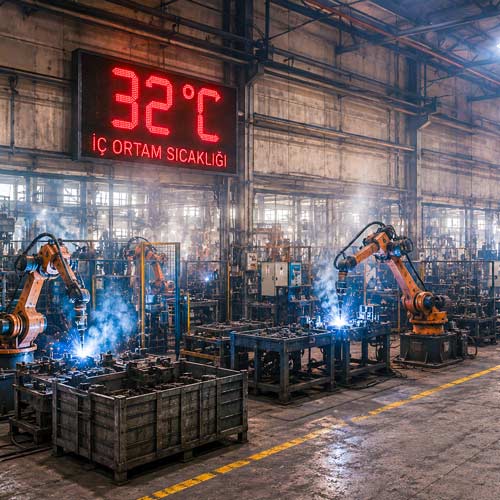
As temperatures rise, reduced air movement combined with intensive production schedules may cause process-generated fumes, dust, and gases to become more noticeable throughout the workplace. For this reason, factory air quality should always be considered an integral part of temperature management rather than an independent issue.
Factory air quality cannot be evaluated solely by whether visible smoke is present. Welding fumes, microscopic metal particles, oil mist, laser processing gases, and grinding dust are often only partially visible. From an occupational exposure perspective, what truly matters is whether these airborne contaminants reach employees’ breathing zones.
You can learn more by reading our article How to Measure Welding Fume Exposure?.
During hot weather, employees working in enclosed manufacturing environments become fatigued more quickly. When poor air quality is added to these conditions, the physical workload increases even further. Therefore, temperature, humidity, airflow, source extraction performance, and filter maintenance should all be monitored together as part of a comprehensive HSE strategy.
Why is air conditioning alone not enough?
Air conditioning systems can reduce ambient temperature, but they cannot capture welding fumes, dust, oil mist, or process gases directly at their source. In industrial facilities, air conditioning and process ventilation serve different purposes and should therefore be designed as complementary systems.
Installing an air conditioning system may improve thermal comfort for employees. However, if welding, grinding, laser cutting, or oil mist-generating processes are taking place within the same production area, contaminants must still be captured directly at their source. Otherwise, cooled air may simply continue circulating hazardous airborne pollutants throughout the facility.
The correct engineering approach is not to consider climate control and industrial filtration as alternatives, but rather as complementary systems that perform different functions. Air conditioning provides thermal comfort, while source extraction and industrial air filtration control process-generated airborne contaminants.
For a detailed comparison, read our article Mobile Welding Fume Extractor or Central Filtration System?.
How should manufacturing facilities prepare for the summer season?
Preparing industrial facilities for hot weather should include temperature measurements, airflow analysis, source extraction inspections, filter maintenance planning, employee break schedules, and energy consumption monitoring. The objective is not simply to reduce temperature, but to maintain safe, sustainable, and productive manufacturing conditions.
1. Measure temperature and airflow throughout the production area
Factory temperature should never be evaluated from a single measurement point. Welding stations, laser processing areas, grinding departments, enclosed robotic cells, maintenance workshops, and high-bay production halls should all be assessed separately. Particular attention should be paid to employee breathing zones and actual working locations.
Our NOVUS Air Filtration Tower, equipped with integrated air quality monitoring sensors, provides continuous analysis of indoor environmental conditions. Learn more here:
https://www.freshweld.com.tr/en/industrial-oil-mist-filtration-tower-ventilation-ncm/
2. Inspect source extraction systems
Extraction arms, welding hoods, downdraft tables, fume extraction torches, and central filtration systems become even more important during hot weather. Employees working in hot environments are less likely to tolerate poorly positioned extraction equipment. If the extraction point is too far from the emission source, contaminants can spread rapidly throughout the workspace.
Discover our HSE-compliant welding fume extraction solutions:
https://www.freshweld.com.tr/en/fume-extraction-solutions/
3. Review filter maintenance schedules
During periods of intensive production, filters may become contaminated more quickly. Differential pressure values, fan performance, automatic cartridge cleaning systems, spark arrestors, and activated carbon filters should all be inspected regularly. Delaying maintenance during the summer months may reduce filtration efficiency while simultaneously increasing energy consumption.
FRESHWELD Maintenance & Modernization Services help keep your filtration systems operating safely and efficiently.
Maintenance & Modernization4. Monitor both energy consumption and airflow performance
High-volume extraction systems can waste conditioned air if airflow is not properly controlled. Airflow requirements should therefore be adjusted according to production intensity and process demand. In central filtration systems, zoning strategies, variable frequency drives (VFDs), automatic dampers, and process-based operating scenarios can significantly reduce the total cost of ownership.
5. Ensure collaboration between HSE, maintenance, and production teams
Temperature management is not solely the responsibility of either the HSE department or the maintenance team. Employee health, production continuity, energy management, and factory air quality should all be addressed through a coordinated approach. Summer-specific inspection routines, preventive maintenance schedules, and operational reviews should therefore be carried out jointly.
Practical Assessment Table for Production Managers
| Risk Area | Potential Impact | Recommended Control Measures |
|---|---|---|
| High indoor temperature | Worker fatigue and reduced shift productivity | Monitor temperature, optimise rest schedules, and analyse airflow patterns. |
| Insufficient air movement | Accumulation of hot air and airborne contaminants within the work area | Evaluate the balance between general ventilation and source extraction systems. |
| Welding fumes and process-generated particles | Increased occupational exposure within employees’ breathing zones | Capture contaminants at the source using correctly positioned extraction equipment. |
| Increasing energy consumption | Higher cooling and ventilation operating costs | Optimise airflow rates, maintain filtration systems, and implement process-based ventilation control. |
| Reduced filtration performance | Lower extraction efficiency and increased fan load | Monitor differential pressure values and perform scheduled preventive maintenance. |
FRESHWELD Perspective:
Temperature Management Cannot Be Separated from Factory Air Quality
Temperature management in industrial facilities is far more complex than simply increasing cooling capacity or installing larger ventilation systems. An effective strategy should consider the manufacturing processes involved, the location where airborne contaminants are generated, employee working positions, and the overall performance of the existing industrial filtration system.
At FRESHWELD, we develop engineering solutions for welding fume extraction, central filtration systems, laser fume extraction, oil mist filtration, dust collection, and process ventilation to help manufacturing facilities maintain cleaner, safer, and more energy-efficient working environments.
During periods of hot weather, a properly engineered source extraction or central filtration system does far more than improve indoor air quality. It also supports employee comfort, production continuity, equipment reliability, HSE performance, and long-term energy efficiency.
Contact Our Technical Team and Let's Choose the Right Product TogetherFrequently Asked Questions
Does high temperature only affect worker comfort in factories?
No. High temperatures can also influence employee health, concentration, equipment performance, ventilation requirements, factory air quality, and overall manufacturing productivity. Heat stress may indirectly affect production quality, operational continuity, and workplace safety.
Is an air conditioning system sufficient for controlling welding fumes or process gases?
No. Air conditioning systems improve thermal comfort but do not capture welding fumes, oil mist, grinding dust, or laser-generated gases at their source. Industrial manufacturing facilities require dedicated source extraction and industrial air filtration systems to control these airborne contaminants effectively.
Why is filter maintenance more important during hot weather?
Ventilation and cooling systems generally operate under greater demand during summer months. Dirty or overloaded filters reduce extraction efficiency, increase fan energy consumption, and negatively affect overall factory air quality. Preventive maintenance helps maintain both system performance and energy efficiency.
How should factory air quality be monitored?
Factory air quality should be assessed by monitoring temperature, airflow, airborne particle concentrations, process-generated fumes, extraction performance, and filter differential pressure. Where necessary, occupational exposure assessments and personal air monitoring should also be performed to ensure HSE compliance.
Conclusion: Hot Weather Has Become Part of Manufacturing Strategy
The increasingly frequent heatwaves experienced across Europe demonstrate that temperature management is no longer a seasonal comfort issue for industrial facilities. Rising temperatures can directly affect employee health, production continuity, energy efficiency, factory air quality, and overall operational performance.
For this reason, preparing manufacturing facilities for summer should involve much more than increasing cooling capacity. Airflow management, source extraction systems, process-generated airborne contaminants, filtration maintenance, and energy consumption should all be evaluated together as part of a comprehensive engineering strategy.
Through the FRESHWELD Industry Insight series, we continue to analyse current industrial challenges from a practical engineering perspective. If you would like to learn more about welding fume extraction, industrial air filtration, factory air quality, and process ventilation solutions, explore the FRESHWELD Knowledge Center or contact our engineering team for a solution tailored to your manufacturing facility.
References
- World Health Organization (WHO) & World Meteorological Organization (WMO) – Protecting Workers from Heat Stress
- International Labour Organization (ILO) – Heat at Work: Implications for Occupational Safety and Health
- UK Met Office – Climate and Heatwave Information
- Associated Press – European Heatwaves and Their Impact on Industry