

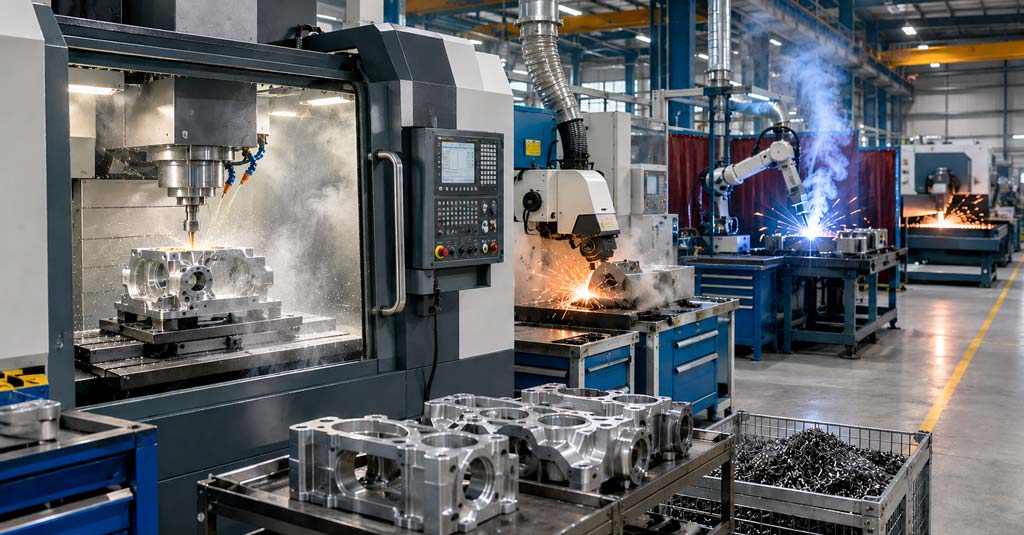
The journey of a metal component through a factory often begins with cutting the raw material and continues through processes such as CNC machining, turning, milling, grinding and welding. Each stage of the metalworking process brings the component closer to its final geometry, while the type and behavior of airborne contaminants generated in the workplace also change.
Fine particles generated during thermal cutting do not have the same characteristics as oil mist that can become airborne around a CNC machine. Likewise, the control method for metal dust generated during grinding differs from the method used to control welding fumes.
For this reason, rather than treating air quality in metalworking facilities simply as a general “ventilation problem,” it is necessary to analyze which contaminant is generated, at which point in the production process.
Effective air filtration in a manufacturing facility begins not only with how much air is extracted, but with correctly identifying which contaminant is generated, where it is generated and during which process.
Cutting: One of the First Emission Sources in a Metal Component’s Production Journey
Thermal cutting technologies such as laser and plasma cutting are widely used to prepare sheet metal, profiles and other metal raw materials for production. During these processes, the material is cut using high energy density, which can release fumes and particles of different sizes into the production environment.
The key point is that the contaminants generated are not limited to coarse metal particles that can be seen around the work area. Thermal processes can also generate much finer particles capable of remaining airborne.
Therefore, a clean-looking area around a cutting machine does not necessarily indicate adequate air quality. Fine suspended particles can be transported beyond the process area by air currents within the production environment.
Especially in high-volume laser and plasma cutting lines, filtration system design should consider not only fan capacity but also process operating time, the material being cut, particulate load, ductwork and the required filtration surface area as an integrated system.
FRESHWELD’s industrial dust collection and central filtration solutions can be engineered for metalworking processes that generate dry fumes and dust, including laser cutting, plasma cutting, grinding and deburring.
CNC Machining: From Visible Chips to Invisible Oil Mist
After cutting, the next stage in a component’s production journey is often CNC machining, turning or milling. At this point, the characteristics of the contaminants in the production environment change significantly.
When machining is discussed, metal chips are usually the first waste material that comes to mind. However, modern CNC machines do not generate only solid waste. High cutting speeds, tool-to-workpiece contact and the use of cutting or cooling fluids can also create airborne contaminants.
Metalworking fluids are used to reduce heat and friction during machining, cool the cutting tool and remove metal particles from the machining zone. According to NIOSH, these fluids can range from straight oils to water-based, semi-synthetic and synthetic formulations. Mist generated during machining can become an aerosol consisting of suspended liquid droplets and contaminants carried with them.
Therefore, the chips visible beneath a CNC machine and the oil mist capable of reaching an operator’s breathing zone are not the same problem.
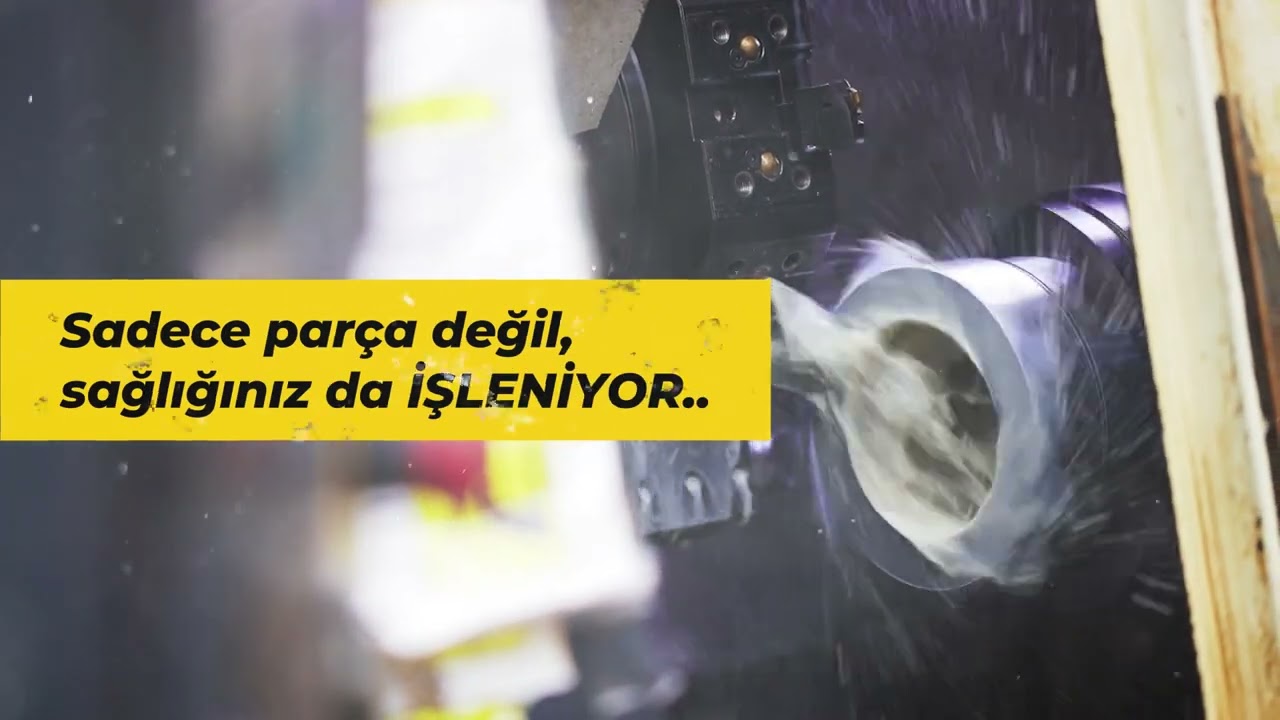
Why doesn’t oil mist remain inside the CNC machine?
At first glance, an enclosed CNC machine may appear to completely isolate the process from the workplace. However, an enclosure does not eliminate the aerosol generated by the process.
As machining continues, oil mist and coolant aerosols can accumulate inside the machine. The amount of mist generated can vary depending on the type and temperature of the metalworking fluid, machining method, process speed, machine enclosure and the effectiveness of ventilation. NIOSH also highlights these factors when assessing exposure to metalworking fluid aerosols.
When the machine door is opened for part changes or maintenance, contaminated air inside the enclosure can be released into the production area. In facilities where many CNC machines operate in the same section, relatively small aerosol emissions from individual machines can accumulate over time and become a broader indoor air quality issue.
For this reason, the objective of oil mist control is not simply to remove visible haze, but to capture the contaminant as close to its point of generation as possible.
Should the same solution be used from a single CNC machine to high-density production lines?
Using the same filtration system for every CNC application is not the correct approach. An oil mist issue at a single enclosed machine and an air quality issue in a large production hall containing dozens of CNC machines require different engineering strategies.
For individual CNC machines, lathes and milling machines, compact systems can extract process air directly from the machine enclosure. For example, FRESHWELD SKY Oil Mist is designed for local filtration of oil mist and microscopic particles generated by CNC machines, lathes and milling applications using cutting or coolant oils.
In heavy-duty machining processes with high oil loads, the filtration technology should be selected accordingly. Coalescence filtration systems such as the FRESHWELD MCOS Series provide a different filtration approach for applications generating high concentrations of oil mist and microscopic particles.
The selection should not be based solely on unit capacity. Machine enclosure volume, cutting fluid type, process intensity, aerosol load and daily operating time should be evaluated together.
Grinding and Sandblasting: As the Surface Changes, So Does the Contaminant
After CNC machining, a metal component may undergo secondary processes such as deburring, grinding, surface finishing or polishing. At this stage, the dominant contaminant in the production line changes once again.
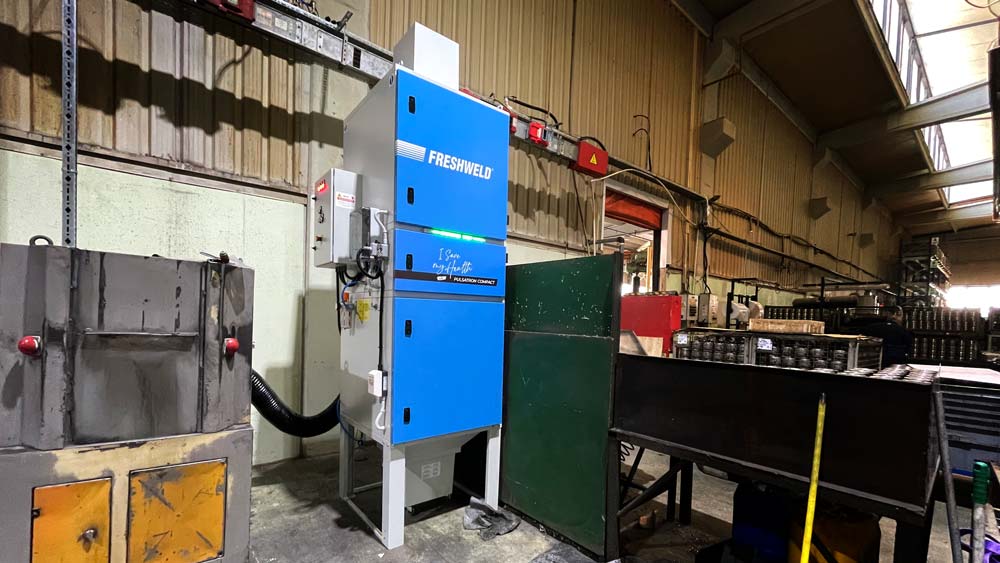
Grinding mechanically removes particles from the material surface. Depending on the application, this can generate metal particles and fine dust in different size ranges. While oil mist and aerosol control were the primary concerns during the preceding CNC operation, effective capture of particulate matter becomes the priority during dry grinding.
This distinction also demonstrates why industrial filtration systems cannot be selected solely on the basis of “high extraction power.”
The same metal component can generate airborne contaminants with completely different characteristics within just a few meters of the production line.
In grinding, polishing and deburring applications that generate dry metal dust, it is important to capture the dust as close to the source as possible. Depending on the process, downdraft worktables or central dust collection systems can be used.
However, not all waste generated during CNC machining and grinding is airborne. Metal chips, burrs, oils and emulsions accumulating inside machines or on floors require different equipment for effective management. FRESHWELD’s industrial high vacuum cleaners are designed for the collection of chips, dust, liquids and other industrial contaminants in metalworking environments.
Welding: A New Emission Source Appears as Metal Components Are Joined
When the metal component reaches the welding stage, the characteristics of the airborne contaminants change once again. The high temperature of the welding arc and the properties of the materials being processed can generate welding fumes consisting of very fine particles, together with process-dependent gases.
At this stage, directly applying an oil mist filter used for CNC machining or a conventional dust collection approach used for grinding to the welding process is not the correct engineering approach.
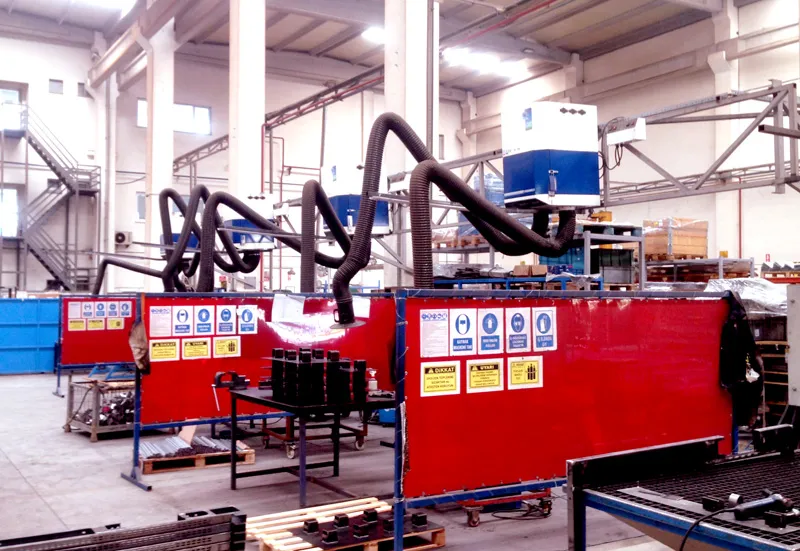
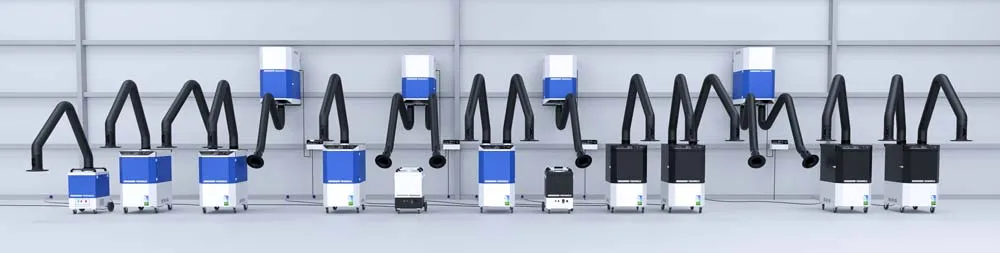
Welding fumes should be captured as close to the source as practicable. Manual welding stations can use mobile welding fume extraction units or fixed articulated fume extraction arms, while production lines with multiple fixed stations may require central fume extraction systems.
The appropriate extraction method for welding depends on parameters including the welding process, number of stations, operating time, component geometry and the operator’s required working range. For this reason, welding fume control should be considered as part of the facility’s overall air quality strategy rather than in isolation from other production processes.
Why Does a Single Factory Need Different Filtration Technologies?
Looking at the entire production journey of a metal component reveals an important point: air quality in a factory is not defined by a single contaminant.
| Production Stage | Dominant Airborne Contaminant | Primary Control Approach |
|---|---|---|
| Laser / Plasma Cutting | Fumes and fine particles | Source extraction and dust filtration |
| CNC / Turning / Milling | Oil mist and metalworking fluid aerosols | Oil mist filtration |
| Grinding / Deburring | Metal dust and particulates | Local extraction or dust collection |
| Welding Stations | Welding fumes and process gases | Local or central fume extraction |
| General Production Area | Dispersed aerosols and fine particles | Ambient air filtration |
This table also highlights an important design mistake: attempting to solve every air quality issue in a production facility with a single general ventilation system.
Wherever practical, the primary approach should be to capture contaminants at the point of generation. However, in large and changing production areas, facilities with many machines, or processes where local extraction is difficult to implement, ambient air filtration can provide a complementary solution.
What Happens in Factories with Large Numbers of CNC Machines?
In automotive, machinery manufacturing, aerospace, defense and high-volume component production facilities in particular, many CNC machines, lathes and milling machines may operate within the same production hall.
Even when the oil mist generated by each individual machine appears limited, the aerosol load dispersed throughout the production area can affect overall air quality over time. In addition, where production layouts change frequently or local ducting infrastructure cannot be implemented, collecting every contaminant source through a fixed duct system may not be practical.
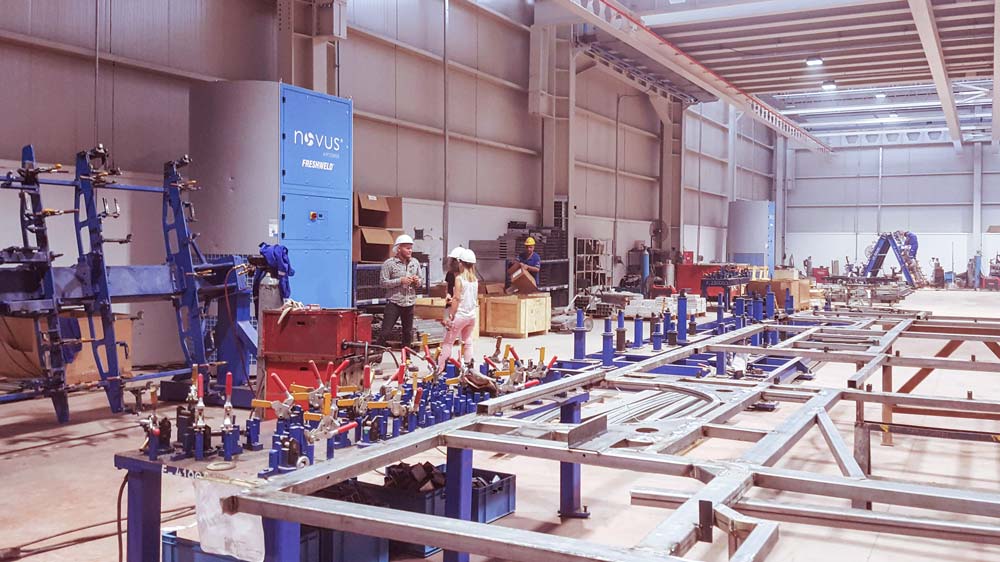
For these applications, ambient air filtration systems such as the FRESHWELD x NOVUS Airtower can be considered. The NOVUS Airtower family is designed to filter oil mist, coolant aerosols and airborne particles generated by intensive CNC and metalworking processes in large and changing production environments.
This approach should not be treated as an alternative to local extraction, but rather as an integrated air quality strategy in which local capture and ambient air filtration are evaluated together according to the facility’s process requirements.
Selecting the Right Filtration System Starts with Understanding the Process
Simply seeing fumes, mist or dust in a factory is not enough to determine which filtration system is required. As a production line moves from laser cutting to CNC machining, grinding and welding, both the physical characteristics of the contaminant and its point of generation change.
Before selecting a system, at minimum the following questions should be answered:
- During which process is the contaminant generated?
- Is the contaminant a dry particulate, fume, oil mist or aerosol?
- Can the contaminant be captured at the source?
- Are the production points fixed or variable?
- How many machines or workstations are located in the same area?
- How many hours per day does production operate?
These factors affect not only the selection of the filtration unit but also the required airflow, filtration technology, extraction method and overall system architecture.
Effective industrial air filtration begins not with installing a single filtration unit in a factory, but with correctly analyzing which contaminant is generated at each stage of the production process.
Conclusion: Follow the Entire Production Process, Not Just the Component
When a metal component enters a factory as raw material, it undergoes different physical and thermal processes throughout production. Fine particles generated during cutting, oil mist and aerosols generated during CNC machining, metal dust from grinding and fumes generated during welding all have different characteristics.
Therefore, an effective air quality strategy should focus not only on filtration unit capacity but on the process > contaminant > filtration relationship.
Particularly in facilities with intensive CNC machining and metalworking operations, oil mist can easily be overshadowed by more visible dust and chip-related issues. Yet as the number of machines and operating hours increase, controlling aerosols generated from metalworking fluids becomes a distinct component of the factory’s overall air quality strategy.
Identify the Right Filtration Technology for Your Production Process
Depending on the characteristics of contaminants generated during cutting, CNC machining, grinding or welding, the appropriate solution may involve local extraction, oil mist filtration, dust collection or ambient air filtration.
By evaluating your production process together with the FRESHWELD engineering team, you can identify the filtration approach best suited to your facility.
Contact Our Technical Team and Let's Choose the Right Product TogetherRelated FRESHWELD Solutions
- SKY Oil Mist – CNC Oil Mist Filtration
- MCOS – High-Density Oil Mist and Micro-Particle Filtration
- NOVUS Airtower – Ambient Oil Mist Filtration
- Industrial Dust Collection Systems
- Mobile Welding Fume Extraction Systems
Related Content
References
- NIOSH – Criteria for a Recommended Standard: Occupational Exposure to Metalworking Fluids, DHHS (NIOSH) Publication No. 98-102, 1998.
- NIOSH – Preventing Health Hazards from Metal Working Fluids.
- NIOSH – Aerosols in the Workplace.