
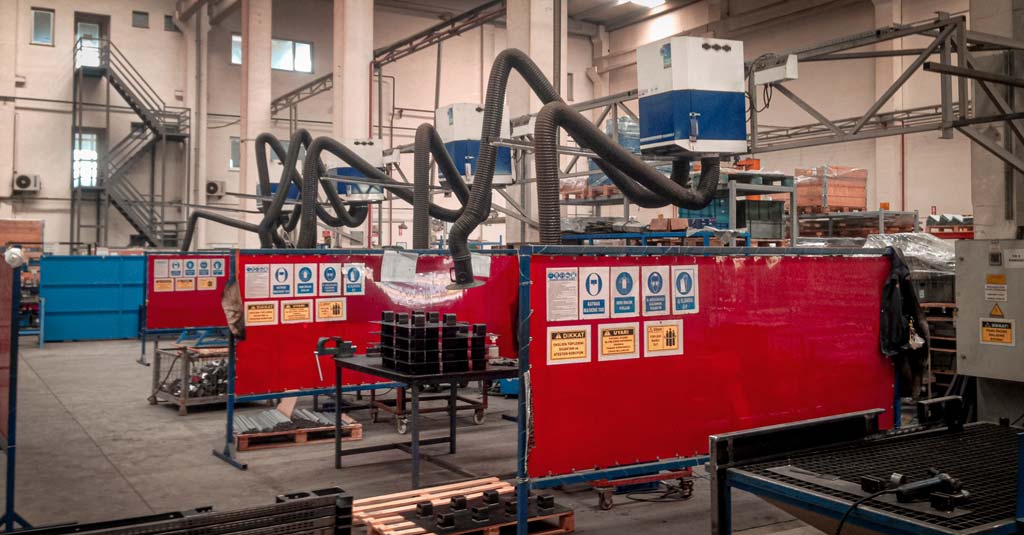
The primary occupational hazard in welding workshops is the radiation emitted during welding and cutting processes — and the health risks this radiation poses to workers.
Approximately 15% of the total energy produced by the welding arc is released into the working environment as radiation. Of this energy, about 60% is infrared radiation and around 10% is ultraviolet radiation. These radiations are known to cause a range of health issues among welders, most notably affecting the eyes and, to a lesser extent, the skin.
Radiation Generated During Welding Processes
Infrared radiation is emitted from hot metals, flames, or the welding arc, producing a heat effect similar to that of burning fuel.
Ultraviolet radiation (UV), on the other hand, is not felt by the skin but behaves like intense sunlight, leading to burns and long-term damage. Its wavelength range plays a crucial role in eye health, as ultraviolet rays are the most harmful component of welding light exposure. These rays fall within the upper range of the visible spectrum and are responsible for severe eye injuries if proper protective equipment is not used.
Workers without welding helmets or safety goggles may instinctively squint or close their eyes to protect themselves from the glare — but this reflex does not offer protection against short-wavelength UV radiation, which cannot be seen and thus cannot trigger the natural eye protection response.
For a detailed explanation of electromagnetic waves, click here.

Protection Against Welding Radiation
To prevent the negative health effects of radiation generated during welding and cutting operations, workers must protect their eyes, face, and all exposed skin areas.
Failure to do so can lead to eye burns, redness, irritation, and other acute symptoms. Over the long term, chronic eye damage can occur — including permanent vision loss or even blindness caused by prolonged UV exposure.
Contact Our Technical Team and Let's Choose the Right Product TogetherAt FRESHWELD, we design and manufacture protective systems for all scales of industrial operations — from small workshops to large manufacturing plants — focusing on personal protective equipment (PPE) that prioritizes human health and workplace safety.